Showing posts with label Education for Poor and Orphaned. Show all posts

Sunday, January 27, 2019

OAR: Our Association for Remedy, Kolkata: Educating the Very Poor


OAR: Our Association for Remedy, Kolkata,

Paschim Banga (West Bengal) State, India:

Providing Education to the Poor and the Bypassed

Dr. Sachi G. Dastidar

Probini Foundation Report; January 25, 2019

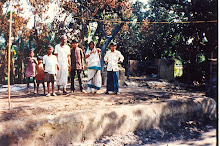
OAR: Our association for Remedy has been educating pavement-dwelling children, children of slums – often on illegally-occupied land. OAR is providing basic education to dozens of children living on illegal property at Maajher Haat Station in Kolkata. Students are mostly from migrant families from neighboring states. Although basic education is free and compulsory there are always thousands of kids who fall through the cracks either for lack of registration or for lack of seats in state-supported schools. The school at Majher Haat Station is called Mukti (Free) and is taught for a couple of hours by two to three teachers for a nominal remuneration. On the day when a Probini delegation arrived on the back of a motorbike the students showed their prowess by reciting several poems and verses, by drawing a “New Year Card” and receiving gifts of pens and pencils in a box bought by Mr. Bikas Biswas, the Project Director and dreamer of big ideas, bought by donation by this writer given on the day of the Probini Meet on January 6, 2019. OAR is planning to acquite a piece of land in southwest Kolkata suburb for an orphanage and a school. May God bless OAR!

Should anyone be interested in learn about OAR one may write to probini@hotmail.com or check Probini page at Facebook or check https://empireslastcasualty.blogspot.com/2008/12/educating-poor-and-orphaned-in.html for further information.

Open Air Classes


Poetry Lessons


Surrounded by Water Buffalo Shed


Railway Land being Cleared for New Construction


Friday, February 3, 2017

Islamizing Bengali Curricula in Bangladesh and Indian West Bengal


Muslim-majority Bangladesh and Hindu-majority West Bengal both are Islamizing Bengali Curricula to appease anti-Pluralistic, Intolerant, Jihadi Islamists

Sachi G. Dastidar

            Note from Bengal: West Bengal, India and Bangladesh

Increasingly both independent Bangladesh and West Bengal State of India – together the former Bengal Province of British India – are Islamizing the Bengali literature and school curricula as per several articles, one appearing in the New York Times, the other in India, yet another one in Bangladesh. Yet the poor and middle class Hindus, Christians, pro-secular Muslims and others of urban and rural West Bengal – with Calcutta (Kolkata) its capital – decry this Islamization and Arabization in every casual conversation yet are too terrified to protest against a perceived tyranny of the ruling elites. This is of course true for morally-and-bravery-challenged West Bengali population. This is not true for Bangladeshis. They are still alive and kicking. 
During a 2017 trip to the Subcontinent what was puzzling to find out how even in 2017 minority Hindu population of Bangladesh is fleeing to India, especially because Bangladesh is apparently being run by a pro-tolerant Awami League party. During a trip to New Garia Station at the southern end of Kolkata (Calcutta) Metro I found one green coconut seller Dilip Babu, or Mr. Dilip, a Hindu, a skeleton of 5 feet tall person, possibly in his fifties, wearing dirty pair of pants and an undershirt when asked said he is from Perojpur, in southern coastal Bangladesh. He knew some individuals I have met from the district: Prof. Chitta Ranjan Mondal, former Member of Bangladesh Parliament Mr. Sudhangshu Sekhar Haldar, among others. He knew a Hindu monk engaged in social work in his homeland. When asked why a poor person like him would migrate to India leaving ancestral homestead, he remarked “for poor oppressed-caste people like us it is increasingly difficult to live there with our family. Women are always a target. Moreover, I don’t think my son would have been able to go to a top engineering college like Bengal Engineering College where he is studying now. There is lots of official discrimination against us.” I asked, “Really?”
I still refuse to believe this.
Then I ran into Bikash, 27, who fled to India 15 years ago. He said after continued fleeing of Hindus our family was one of the few minority Hindu families left our Barisal village. My father is a well-known school teacher. To drive us out there were 11 night-time attack by dacoits (armed gangs) on our family, but wealthy Muslim families were spared. All of our movable assets were taken away. We were afraid of being killed. When we saw our attackers in the bazaar the police said “don’t report to us. We won’t arrest them.” Finally during an attack by Muslim thugs they kicked my father in the back so hard that he was hospitalized and his back was almost broken. Then my parents said that I must leave our homeland for India. I left my parents when I was 12. I crossed the border illegally through a smuggler. Now I am 27. I have obtained an Indian passport. I haven’t seen them in 15 years.” What is worth noting that this high-energy boy, a step away from being a street child himself, has opened an N.G.O. to educate street children at MajherHaat in Kolkata! 

Then there was this Kolkata (Calcutta) carpenter, Tarun M, a young Hindu of early 30s, skinny, possibly 5’ 3”, when asked where he is from, answered “South 24 Parganas District,” a southern suburb of Kolkata connected by suburban train service. But his accent gave away his identity. Then he said, “I am actually from Hatia Island near Chittagong City in Bangladesh, you wouldn’t know that place. I came recently.” I asked “Weren’t there need for carpenters in Chittagong, a booming metropolis?” He replied, “Uncle, do you know anything of my desh (homeland)? How can a poor or bhadralok (i.e. middle class) Hindu live there? Although many of my family members (i.e. parents, brothers, sisters, uncles, aunts) still live there, but they live subjugated. They can’t say anything including when they are robbed.”

“Don’t you live like a second-class subjugated citizen anyway in a foreign India?”

“No, uncle. I have a ration card, ID card, and even a voter card. Our women are not threatened. No one takes our crop forcefully. I paid (bribe) to local TrinaMool (ruling West Bengal State) politicians and police to get those cards.” Then he quickly added, “It is not just Hindus but majority Muslim Bangladeshis are also coming to West Bengal and getting all these (IDs).” He then pointed to the Muslim workers at the construction site across the street. “Ask them.”


Incidentally, construction is one of the few areas where low-skill individuals can get a job in urban sector after the demise of industrial sector in post-independence (1947) India once Communist Party of India-Marxist (CPM) took state power in 1977 in India’s second-most industrial state. During the 34 years of their rule tens of thousands of factories closed due to Communist agitation. By the time there was an effort to bring back industrial jobs CPM was ousted by a virulent anti-Communist Miss Mamata Banerji of TrinaMool (Grassroots) Congress Party. She too has failed to attract jobs because of her ultra-populist rhetoric. But the construction sector remains a bright spot as 90-million strong West Bengalis who now find jobs out-of-the-state for lack of development in the state buys homes for their retirement or for their parents who live in the state. There is a belief among many that these construction jobs are being taken by Bangladeshis not West Bengalis. This is a serious issue, true or false, and can turn into violence and political liability unless checked early.

Wouldn’t it be beneficial for both Bangladesh and West Bengal if folks like Tarun, Dilip and Bikash were able to serve their Bangladesh homeland? Then there is Aunt Shil Mashi, a widow, surviving away from her homeland. When asked why she has left her ancestral land, she just said, “How can we live there?” Why a stable, pro-tolerant Bangladesh Government is not able to keep their Hindu minority for their own benefit still puzzles many. Is Islamization of Bangladesh education speeding up the process? Is Hindu-majority West Bengal also heading in the direction of anti-Hindu Islamization? Where would West Bengalis flee then? 

Here are a few recent articles:

New York Times article of January 23, 2017 by Ellen Barry and Julfikar Ali Manik: To Secular Bangladeshis, Textbook Changes Are a Harbinger


Check for Hasan Ferdous' column on (daily) Prothom Alo, Dhaka Bangladesh


From Dainik Jugasankha, January 23, 2017
Nobel Laureate Rabindranath Tagore is out because he used the word "temple" in his poetry:


NY Times 
The Opinion Pages | Op-Ed Contributor
Bangladesh’s Creeping Islamism

By K. ANIS AHMED FEB. 3, 2017 

West Bengal, India

Here is an article of Islamization of Education in Hindu-majority West Bengal State:

Secularising gone wrong? Row after Bengal government replaces 'RAM' with rong in textbook rainbows
The commonly used Bengali term for a rainbow is "Ramdhonu", which literally translates to "Ram's Bow" has now been replaced by "Rongdhonu" in the new text books. 

by Indrajit Kundu  | Kolkata, January 13, 2017 


Hindu-majority West Bengal bans traditional celebration of Saraswati (Goddess of Learning) Puja (service) performed for generations:

"Saraswati Puja stopped at Tehatta High school"

"Controversy at GourBanga [univ 
ersity] with Vice Chancellor's order to Stop Saraswati Puja"

Comment:
Thanks, Sachida. Enjoyed reading it.  
Hasan; February 4, 2017

Monday, February 29, 2016

Bangladesh: River of Humanity Celebrated Centenary of Hindu Pranab Ashram and Student Dorm 2016


    In Bangladesh a River of Humanity Celebrated a Centenary of Hindu Pranab Ashram and the First Student Dorm, January 2016
By Dr. Shefali S. Dastidar
Founder, Probini Foundation, USA
 
 
February 2016

Crowd at the Entrance
In the 1990s when the Madaripur Ashram was in serious hardship they approached Probini via Probini-supported Mahilara Ashram where Probini had just established a school and a building named Nihar Kana Bhaktabash and Bidyaloy (residence for devotees and school). The Madaripur Ashram was headed by then Brahmachari (monk-in-training) Jiban Maharaj. Maharaj received his monkshood thereafter becoming a swami or ordained monk from the Bharat Sevasram Sangha monastic order founded by Swami Pranavananda – also a freedom fighter of Indian independence – in nearby Bajitpur village in early 1910s. Afterwards Dr. Sachi G. Dastidar of Probini visited the place to ascertain the need while staying at the Legal Aid Society’s guest house. Condition of the ashram then was truly wretched as the ashram, Hindu temple, boys’ dorm, devotee residences were destroyed in 1971 by the Army of the Islamic Republic of Pakistan and its Bengali Islamist allies. A Muslim family had built an illegal two story building on the property. With much efforts from the swami and Sachi the ashram was liberated, illegal occupier removed by the local administration and Probini rebuilding the boys’ dorm starting a revival of teaching, learning and prayer at the ashram. (The expanded boys’ dorm now has 52 residents living on campus. For additional information please see http://empireslastcasualty.blogspot.com/2008/12/educating-poor-and-orphaned-in.html.)


A Section of the Crowd in the Pandal (marquee) Area

Probini Foundation received an invitation from Rev. Jibon Maharaj – Swami Satyapriyananda – of Madaripur Seva Asram, Pathak-Kandi, Bangladesh to attend a Centenary Celebration of the Ashram and the boys’ dorm, and 121 years Birthday Celebration of Swami Prnavananda. This writer arrived there before January 22nd, the day of celebration, when the Pathak-Kandi area of Madaripur City was in the mood of celebration. The boys of the Probini-built dorm started decorating the pandal (marquee), and prepare for music the night before the event. The invited guests stayed in guest rooms named Ganga, Yamuna and Sarasvati, the holy rivers. The celebration started with a puja-prayer. Rev. Swami Prottananda and Rev. Swapan Maharaj from nearby Bajitpur Ashram, and headquarter of Swami Pranab Order, did the puja and coordinated cultural events. All the local politicians, Members of Parliament, administrators – all Muslim – prominent engineers, architects, teachers, doctors and other professionals – Muslim and Hindu – attended the event, along with tens of thousands of poor, oppressed-caste Hindus – peasants, petty traders, sweepers, laborers, office workers – joined in the prayer service. It was a mind boggling experience for me. Hindus, especially women and children from nearby areas and Pathak-Kandi started gathering there since early morning. It was like a massive human joyful population, more like a river of flowing Hindus in the Muslim-majority nation following their indigenous tradition. There were many Muslims who came to celebrate the event as well. On one side of the ashram compound a dais and a pandal was built for puja by Rev. Swami Prottanandaji. The cultural program was moderated by Swapan Maharaj. All the artists were from Madaripur District. Several thousand people from the neighborhood patiently attended the entire event. Several politicians and dignitaries gave their speech, including this writer. Bhog Prasad (blessed food) was served to all devotees after the service. What was truly inspiring is that so many of the oppressed individuals told me that “now that you are with us we will serve our homeland, fight to make it better and tolerant, yet not leave the land of our ancestors to flee to India. Om Shanti. Om Peace.”  It was wonderful to hear those words.


Dignitaries at the Dias with Hindu Monks
Seeing a place come alive from total destruction was really a miracle and uplifting event for me.

A Section of Devotees at Sri Sri Durga Mandir Temple


At Bhog Prasad (Blessed Food)


Music Program of Rev. Swapan Maharaj, a Hindu Monk of Bajitpur, Bangladesh


Comments:

March 24, 2016

Tks!  Very uplifting.  I will share with Linda.

Mrs. Laura Healey

April 8, 2016
*****************************
awesome!

Thanks
Professor Dr. Naresh Gupta

May 7, 2016
****************************

Dr. Dastidar:

Happy Shiv Ratri!

A very encouraging and refreshing news from Bangladesh on auspicious day of Maha Shiv Ratri.
Hindus of Bangladesh are not oppressed castes, as mentioned in your article, but Kshatriyas.
They are the protectors of Hindu religion, thus Kshatriyas by Karma (Lord Krishna in Bhagawad Gita,)
Maharishi Valmiki, author of Sanskrit Ramayana, is known as a Maharishi, a Brahmin of highest order. Maharishi Vyas Dev is known as author of 18 Puranas and Mahabharat. Chandra Gupta Mauria was greatest Hindu king. Nobody cares for their caste.  

Suggestion: Please advise the Bangladeshi Hindu teachers and professors to use "Acharyas, Guru," priests to use "Purohits, Panda," doctors to use  "Vaidyas or Doctors," and attorneys to use "Vakils or Judge"  soldiers and policemen to use "Singhs," technical professional as "Engineers," businessmen as "Baniks or Sahas" etc. (as most of the Indian Hindus do.) Please, help them rise in caste hierarchy thru education and diversifying their professions. Eventually oppressed castes will disappear in a decade or two. Good luck!

Bal Krishan Gupta, U.S.A.