Wednesday, December 31, 2008

Indus Valley Civilization: Harappa

Harappa: 2,700 - 3,000 BC Indus/Indian Civilization Site

Indus Valley Approximate Sites


HARAPPA –

Visit to the Ancient city of Indus Civilization

Dr. Sachi Ghosh Dastidar,

and

Dr. Shefali Sengupta Dastidar

            From our college days we wanted to visit Harappa and MohenjoDaro, prehistoric cities of Indian and Hindu civilizations and culture. Our first attempt to visit MohenjoDaro in late 1980s failed because of civil disorders in Pakistan. Then on a trip to Lahore in late 2000s, the cultural capital of Pakistani Punjab as well as all of Pakistan, we decided to visit our heritage site. Our Lahore host Professor Sindhu and her mother, whom we called Didi, older sister, found us a nice air-con sedan for us to make the trip. We invited the mother and daughter to join with us as they had never seen the place, leaving behind her other grown children Shahid, Shabnam, Rizwan and Nabila for our day trip. Soon we realized that not very many people in Lahore know about Harappa.
Harappa is a nice place for a day trip from Lahore which is about 175 kilometers away (some literature say it is 250 kilometers away,) and can be easily made in 3 hours. The journey was quite pleasant as we passed villages after villages in that flat, green farming countryside. There were no big signs to the site and the driver had to ask locals for direction. Our first surprise came when the driver passed the turn because of lack of signage. The road sign it was partly damaged and written in mid-sized Urdu letters, not easily visible from a passing car. At the ticket counter realizing entry fees to be 20 times higher for foreigners Didi wanted us to pass for locals to save money. The official at the counter was agreeable for Sachi to pass for a local with his Bengali “half-punjabi shirt,” but he would have none of it with Shefali wearing pants. As we were traveling for over 5,000 kilometers, mostly by road crossing many national boundaries, we were carrying two small carry-ons. We had limited supply of local outfit with Shefali carrying only one sari which she forgot to wear that day. “No Pakistani woman wears pants,” was his answer. Harappa can be reached by train or bus from Lahore via nearby Sahiwal town. One can easily have lunch, tea and dinner in roadside dhabas or eateries.
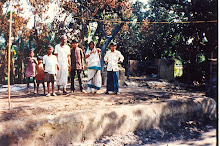
Walking down the brick paths was exhilarating, exciting and hallucinating for us. It was “a dream come true.” The entrance in English and Urdu introduction says, “MOUND ‘AB’ CENTRAL: The high level of Mound is the result of continuous rebuilding of the city. In this area the curved wall situated is actually what may have been a drain during the final phase of Harappa occupation around 2200 and 1900 B.C. In the lower levels there is a large well and a bathing platform that belongs to an earlier period. This may have been public well associated with a bathing and washing area. Unlike Mohenjodaro where there are discovered numerous wells in each neighborhood, as yet only eight wells have been discovered in Harappa. Some of them were private and some were public wells. Much of the top structures were robbed by the contractors who built the Lahore, Multan railway track during British rule. The lower structures were destroyed by the Harappan inhabitants to reconstruct their houses. The archeological excavations were conducted here by Raj Bahadur Daya Ram Shani and M. S. Vats during 1921 to 1924 A.D. and 1926 to 1934 A.D. (For more details visit the Web site: www.harappa.com)” As there were no other visitors, the security police doubled as a guide. This was good for us, but sad for Pakistan, India and for students of Indus and Indian Civilization. There was no rush of humanity – peasants and babus – as in Sarnath and Kashi Viswanath in Varanasi, Kutub Minar in Delhi, Jaliiwanwala Bagh in Amritsar, Victoria Memorial in Calcutta, Ajanta in Maharashtra, Konark in Orissa, Bagan in Burma, or Gaya in Bihar. To us this solitude also felt even more contrasting as we visited Xian in China a few days earlier on this trip. In terracotta warrior-famed Xian, discovered only in 1970s, the China has built a huge air-conditioned dome covering the entire site protecting it from the elements, and in that process had made Xian the second-most visited place in China bringing millions of tourists with billions of dollars of income and creating tens of thousands of jobs. To protect the structures from further erosion in Harappa many of them have been covered with plasters. The area is in further jeopardy because of a water buffalo farm on its unguarded boundary and a Muslim grave within the pre-historic city itself. Even at a leisurely pace the site can be visited in an hour or two. Now it is several kilometers away from the river on whose bank it was located.

There is a small museum and a gift shop at its entrance run by the Archeological Department. A number of booklets on the prehistoric city are available at the counter. All the workers were eager to show us their collection. As we were almost at the end of our long journey we bought one copy each of their collection because we won’t have to hand carry for too long. (Space on our small boxes could be made only by discarding some of our belongings.) As we were departing, the entire crew said, “Come again, our Hindu friends.”


Introduction of Harappa Site in Punjab, Pakistan

Ruins of Well

Parts of Harappa City


A Section of the City

A Housing Area

Site of Industrial Neighborhood

Granery Location

Top View of the Ancient City


Pictures: 2007

Stranded Pakistanis Vote in Bangladesh: 2008

In Bangladesh Biharis (Stranded Pakistanis) cast Vote in General Election-2008: First Time Ever
Stranded Biharis known as Biharis, exercised their franchise for the first time on Monday in the 9 th Parliamentary election in independent Bangladesh, they are treated as minority in Bangladesh. After liberation of Bangladesh those Biharis have not been treated as citizen of Bangladesh.
The Biharis who achieved the voting rights following the High court orders, thronged the polling centers at different places in a festive mood since morning of 29 th Dec, 08.
The Biharis came out of their respective city slums in the sunny morning and cast votes with a high hope that the next elected government would resolve their problems.
They said that only 20 percent Biaris could enlist their names in the voters list and sought co-operation from the next government so that the dropped Bihari voters can register their names in the voter list in January.
Talking to BDMW some of the Biharis said their demands have partially been fulfilled as they are allowed to cast votes in the crucial 9 th Parliament Election. "We should no longer be treated as stranded Pakistanis"
Asked if they have any preference for a particular political party, most of the Biharis said they are not particularly worried about this. They are looking for an honest and patriotic government which will ensure their basis rights.

Through:
Adv.Rabindra Ghosh
Founder President of Banglaldesh Minority Watch (BDMW)
12, K.M. Das Lane, Tikatuly Bholagiri Trust, Ist Floor Sutrapur P.s. Dhaka, Bangladesh
www.bdmw.org

Bangladesh Election 2008 Analysis

Bangladesh Election Analysis
Asif Saleh; December 30, 08
The Guardian, U.K.

Two miracles happened in Bangladesh yesterday. Firstly, 80% of theBangladeshi electorate – a record number – voted in one of the mostpeaceful elections in the country's history. Secondly, they voted fora party that believes in secularism and by a majority big enough forit to control 85% of the parliamentary seats.It's a resounding endorsement of democracy and an emphatic victory forpluralism in the world's second-largest Muslim majority country.Although International media finds it easy to do a stereotypicalportrayal of the "dysfunctional two begums", the real story ofBangladesh, however, is in the details.In focusing so much on the two Battling Begums and the occasionalstories on Islamic extremism, the media tend to overlook the progressBangladesh has made under the two begums, its vibrant civil societyand its "dysfunctional democracy". Yesterday's election and itsoutcome is a continuation of that progress.What was even more remarkable in the election yesterday was the strongsignal sent to the political parties by the voters: reform or perish.They have abandoned the parties that ran a fearmongering campaign,used religion in politics and showed no intention to reformthemselves. On the other hand, they embraced the party that nominateda group of fresh politicians, talked about a vision of a pluralisticand developed Bangladesh and championed separation of religion andpolitics.However, those who expect an overnight full-scale reform will bedisappointed unless they accept that such reforms come through a slowand iterative process. They should take heart in the fact that theelectorate is aware and powerful and will not hesitate to obliterate aparty to send a message unless they change. No one found this out morepainfully than Khaleda Zia, the head of Bangladesh Nationalist Party,who failed to reverse the downfall of her party even after ahard-hitting campaign where she sought forgiveness from the public forpast mistakes.The public were in no forgiving mood, not only reducing its seats by90% but almost wiping out its alliance partner, Jamaat-e-Islami, whoseleaders have been accused of war crimes.Does this mean a new beginning for Bangladesh? That will depend partlyon how well the secularists can deliver beyond the rhetoric andcontinue the institution-building; and partly on army's staying awayfrom extra-constitutional intervention. Our dreams may be in for arude awakening in a few months like so many other times. But today, asBangladeshis, we are believers. We are daring to dream again.


http://www.guardian.co.uk/commentisfree/2008/dec/30/bangladesh

Tuesday, December 30, 2008

Living among the Believer: Stories from the Holy Land down the Ganges


Living among the Believer: Stories from the Holy Land down the Ganges


Living among the Believers (2006) is a collection of 18 selected stories. It is a byproduct of 25 years of field work. Stories are based on life of victims and survivors — mostly minority, oppressed-caste, often dirt-poor, frequently women and unlettered, and of tormentors and protectors — stories told to the author and his family or as he witnessed firsthand down the Ganga River. Stories cover life in post-Partition (1947) Subcontinent: Bangladesh and West Bengal. These stories broadly cover ethnic, women’s, human rights and cultural issues. Some stories shadow Bengali articles written for the author’s Ai Bangla, Oi Bangla (This Bengal, That Bengal; 1991) and A Aamaar Desh (This is my Home; 1998). One article is based on a 2005 Keynote Speech in Bangladesh. Different Bengali versions of a few of the short stories were published in Puja journals in New York City.

Dr. Sachi (Sabyasachi) Ghosh Dastidar is a Distinguished Service Professor of the State University of New York at Old Westbury. He has taught in the U.S., Kazakhstan and India. He has also worked in Florida, Tennessee and West Bengal. Dastidar was an elected Board Member of a New York City School district making him the first Bengali-American to hold a popularly elected position in the U.S.


Sachi Dastidar has authored six books, including Ai Bangla, Oi Bangla (19920, A Aamaar Desh, (1998), Regional Disparities and Regional Development Planning of West Bengal with Shefali S. Dastidar (1990), Central Asian Journal of Management, Economics and Social Research (2000) and Living Among the Believers (2006). He has written over 100 articles, short stories and travelogues.


His awards include Senior Fulbright Award, Distinguished Service Professor of the State University of New York, and honors from New York City Comptroller, NYC Council Speaker, residents of Mahilara, Madaripur and Uzirpur, all of Bangladesh, Assam Buddhist Vihar, and from Kazakhstan Institute. He has traveled to over 60 countries in all seven continents including Antarctica.
Probini Foundation (http://www.prohini.org/) that his wife and he founded helps educated the orphaned and the poor in 18 institutions in Bangladesh, West Bengal and Assam.


Publisher: Firma KLM Publishers, Kolkata (Calcutta), India

Price: $ 15.95


(Please call 609-448-7225 in New Jersey to procure a copy, or Muktadhara Booksellers of New York at 718-565-7258; or check Internet.)


ISBN: 81-7102-151- 4


"We Urgently Need a Strong Protector Like the Author"
Author: Chittabrata Palit
Publication: Dainik Statesman
Date: February 21, 2007
Book Review - Living Among the Believers: Stories from the Holy land down the Ganges, by Sachi G. Dastidar
The reviewed book's writer is Sachi or Sabyasachi Ghosh Dastidar who is a distinguished professor of State University of New York at Old Westbury. He is an uncompromising fighter for human rights. By birth this author is of Bengal-origin. He has investigated oppression of Hindu minorities in Bangladesh for many decades. Through 18 story-telling he has composed the book. The main actors of those stories are all oppressed, some living while others are dead. Most of the people are from oppressed-caste, mostly women, members of the grassroots. While telling their stories he has also exposed the mask of the oppressors. "The Ganga [Ganges] flows through Bengal" is the story continues to being told since the days of (1947) partition. The aim of the book is to establish human rights. The first story, NivaRani Goes to Heaven, tells us how the movable and unmovable assets of a widow were confiscated.
Again, in SriKanta story, that property confiscation chronicle is being told. In that story how the minority Christian community is struggling to protect themselves and survive is being told. In the last story, "Miracles happen even today," tell us how Mr. NabaGopal held on to his dear village and survived in spite of oppression and assaults. There is a description about him. All his stories show that it is more of greed of minority assets than oppression of (Hindu) minority is the root cause of atrocities. In that question of religion has come up; only minority properties are being forcefully taken over. To do that oppression of women has become necessary. It is not just to oppress minority women that those atrocities are being done. Those animalistic atrocities got entangled with taking over their (Hindu) assets.
Yet, in many stories the writer has shown where communal harmony has existed. He has written about where Hindus and Muslims have acted as brothers. In the Fall Festival (Durga Puja) both the communities have celebrated together. That who has survived, their hope is for a better future. Not that those terrible religious atrocities didn't happen. In terrible killings both East and West Bengal have been destroyed themselves. Again, through the course of nature those broken relationship have come together. Nostalgia has driven Bengalis towards their place of birth, and toward one God.
Once after returning home for puja one found that most of the loved ones are gone. There is no trace of minority Hindus. After many tries some of the old acquaintances were found. For those who were not found, tarpan (prayer offering) for the ancestors was done. The old home was left uninhabited. Yet, Ganga still continued to flow. To visit one's own ancestral home there is so many barriers, so many obstacles. Even there is bloodshed. Recently, Mr. Van Shendel has proposed a barrier-free united Bengal in his "Bengal Borderland" book. There will be two states and two governments but no border. There will be travel from East to West and West to East; and there will be continued conflicts. Today, because of market economy communal conflict has gone down quite a bit. Moreover, lots of time has passed. The ferocious condition immediately after partition is also gone. Either the minorities are safe now or they are almost extinct.
Yet Bangladesh is not a peaceful place. In the name of religion lots of anti-religious activities acts are being committed. Truly there is a need for a steadfast protector like the author. This book will make our rulers more conscious. I wish large circulation of this book.

Please write to Debika Chowdhury (bishwabangali@gmail.com, 646-256-3404) for questions.

Empire's Last Casualty: Indian Subcomtinent's Vanishing Hindu and Other Minorities

Empire's Last Casualty: Indian Subcontinent's Vanishing Hindu and Other Minorities


Empire's Last Casualty: Indian Subcontinent's Vanishing Hindu and Other Minorities (2008) is a study of effects of religious communalism on a pluralistic, tolerant, multi-religious society. It focuses on the loss of indigenous Hindu population from the land of their ancestors; and on changes brought about since a multi-religious progressive region of Colonial British India was partitioned in 1947, and its effects on Hindu and non-Muslim (Buddhist and Christian) minorities, on pluralism and on indigenous cultures. After Britain's Muslim-Hindu partition of Bengal Province east Bengal became Muslim-majority East Pakistan, a part of Islamic Republic of Pakistan, unleashing regular, merciless anti-Hindu pogroms by intolerant Islamists. West Bengal remained in India, with Muslim minority and ever-growing massive Bengali Hindu refugee who turned towards left extremism. Following a 1971 war of independence against West Pakistan, Bangladesh gained independence, creating the second largest Muslim-majority nation. That war was concurrently anti-Hindu and anti-Bengali genocide by Islamic Republic's army and its Bengali and Urdu speaking Islamist allies. The book documents the decade-wise "missing" Hindus from Bangladesh Census: over 49 million; larger than 163 of 189 nations listed in World Bank's April 2003 World Development indicators database, and between 3.1 million (larger than 75 of 189 nations) and 1.4 million Hindus lost their lives through the process of Islamization. Documenting three million-plus lost lives have been painful and difficult; especially when Hindus cremate their dead. Additionally rivers of the world's largest delta washed away signs of mass murder leaving no clue. All attempts have been made to justify the data presented in the book, hardly-known to the world and rarely discussed in Bengal itself.

Dr. Sachi (Sabyasachi) Ghosh Dastidar is a Distinguished Service Professor of the State University of New York at Old Westbury. He has taught in the U.S., Kazakhstan and India. He has also worked in Florida, Tennessee and West Bengal. Dastidar was an elected Board Member of a New York City School district making him the first Bengali-American to hold a popularly elected position in the U.S.


Sachi Dastidar has authored seven books, A Aamaar Desh, (1998), Regional Disparities and Regional Development Planning of West Bengal with Shefali S. Dastidar (1990), Central Asian Journal of Management, Economics and Social Research (2000) and Living Among the Believers (2006). He has written over 100 articles, short stories and travelogues.
His awards include Senior Fulbright Award, Distinguished Service Professor of the State University of New York, and honors from New York City Comptroller, NYC Council Speaker, residents of Mahilara, Madaripur and Uzirpur, all of Bangladesh, Assam Buddhist Vihar, and from Kazakhstan Institute. He has traveled to over 63 countries in all seven continents including Antarctica.


Publisher: Firma KLM Publishers, Kolkata (Calcutta), India

ISBN: 81-7102-151- 4

Few Comments/Reviews:

Link: http://www.dailypioneer.com/280869/Vanishing-minorities.html

AGENDA Sunday, September 5, 2010

Vanishing minorities Empire’s Last Casualty Author: Sachi Ghosh Dastidar Publisher: Firma KLM. Hindus are facing existential crisis in Bangladesh, yet no one is raising the issue, says Saradindu MukherjiStudy of forced migration or refugees has been deliberately neglected by Indian social scientists primarily because of India’s ‘secular’ politics and ‘progressive’ social science research! This negationism is also due to the diktat of their international patrons whose policy is to prop up Pakistan and Bangladesh as normal state systems. Muslim separatist tendencies were the basic factors behind Partition. Pakistan was created on the specific demands made by the Muslim League, and it was duly supported by its permanent collaborators — the Indian Communists. The existing accounts on Partition usually “balance” the guilt and sufferings of both the communities in equal measure, and then, blame everything on the British. On the subsequent persecution, discrimination, dispossession and ethno-religious cleansing of Hindus, Sikhs, Buddhists, etc, the literature is scanty. Herein lies the importance of the book, Empire’s Last Casualty, by Sachi Ghosh Dastidar, a senior academic in the State University of New York and a refugee from East Pakistan.The plight of Hindus in eastern Bengal (later called East Pakistan and currently Bangladesh) is one of the most traumatic stories in the history of human civilisation — comparable in scale to the elimination of the Pagans, Zoroastrians, Hindus and Buddhists by their Islamic conquerors across the world. The sufferings of the aborigines of Australia, the Orang Aslis in Malaysia and that of the native “Indians” by their European conquerors belong to the same category of brutality.Hindus/Buddhists, who constituted 30 per cent of Bangladesh’s population in 1947, have been reduced to less than 10 per cent. The “missing population” amounting to about 25 million are to be found in their unabated mass migration to India, conversion to Islam and merciless elimination. And even this reduction to 30 per cent in 1947 had occurred in a few centuries following Bakhtiyar Khilji’s invasion of Bengal. Thus, the “original sin” cannot be ascribed to the British Empire!The differences between how the non-Muslims suffered in the West and the East had been described by this reviewer thus: “In Islamic parlance, it may be said that while Hindus and Sikhs in West Pakistan were subjected to jhatka (instant slaughter) at one go, Hindus and Buddhists in East Pakistan became items for halal — the process of slow slitting of the head from the torso” (Subjects, Citizens and Refugees: Tragedy in the Chittagong Hill Tracts 1947-1998).It must have been a challenge for Dastidar to write this book, as “documentation of migration is one thing, but the documentation of outright killing of Hindus is extremely complicated, stressful and difficult”. And yet he has done this “painful” job well. Through graphs, charts, photographs and original primary source materials, he brings out the heart-rending story of the Direct Action (August 1946) in Calcutta, Noakhali pogroms and other genocides of 1950, 1964, 1970, 1989, 1992, 2001-2 and many more. This gory story of torture, cold-blooded murder and forced conversion, usually backed by the state power and the “holy” men, makes one devastated. The Bangladesh war of independence itself saw the killing of three million people, with more than 90 per cent being Hindus. He also mentions the plight of the Jumma people in the Chittagong Hill Tracts, and how Khulna, a Hindu-majority district, has been turned into a Hindu-minority district, and how the Muslim population is increasing dangerously in West Bengal.Dastidar rightly wonders why the ruling political parties in West Bengal dominated by Hindu refugees from the east have never uttered a word on the tragedy of their own kinsmen left behind. He is right in asking why no one in India wanted the Pakistanis responsible for killing three million people during the war of liberation to be put on trial. Why have their harassment, humiliation and exodus continued? Why does the international community keep quiet?With the exception of Syama Prasad Mookerjee, who had resigned from the Nehru Cabinet on this issue, no high-profile person — not even Amartya Sen and Mahasweta Devi with their roots in eastern Bengal — has ever uttered a word on this unending genocide.The Appendix provides the famous speech of Dhirendranath Dutta (who was later killed by the Pakistanis in 1971) in the Pakistani parliament, pleading for the inclusion of Bangla as one of the official languages in Pakistan. It also has the letter of resignation of Jogendra Nath Mandal, a Scheduled Caste Minister in the Pakistani Cabinet (who fled from Pakistan to India), CIA’s (Kissinger!) role in the brutal coup against Sheikh Mujib and the elimination of most of his family members.This is a book of rare candour and commitment. The editing, however, could have been more rigorous.

-- The reviewer is professor, University of Delhi, and an expert on Bangladesh

Review in Probini Digest (New York), Spring 2008; p 2 & 4

In his latest book, Empire’s Last Casualty: Indian Subcontinent’s Vanishing Hindu and Other Minorities (2008, Firma KLM, Calcutta: $29.), Dr. Sachi G. Dastidar focuses on the effects of religious communalism on the human rights and survival of the indigenous Hindu and other Christian and Buddhist minorities of Bangladesh/East Pakistan/East Bengal. The book aims to break down what Dr. Dastidar terms the “taboo of silence” in Bangladesh and in the Indian province of West Bengal, as elsewhere in India, with respect to the plight of Bengali minorities since partition by providing quantitative estimates of the vanishing Hindu population principally, but not exclusively. This pioneering study so attempts to provide an answer to the question posed in private by poor villagers and oppressed castes to the author during his travels in the Subcontinent: “Kaku/Babu” (Uncle/Sir), “aamago lokera jai koi?” (Where do my people go?)

Bengal Province in British India is at first described as having linguistic and cultural homogeneity, religious tolerance and peaceful coexistence prior to1905 when it was initially partitioned by the Colonial Administration. Although Bengal was reunited in 1912, Muslim-Hindu communal rioting continued to characterize Bengali politics to the 1947 partition of India into the Dominion of Pakistan (later Islamic Republic of Pakistan) and the Union of India (later Republic of India). While Dr. Dastidar’s main time frame of analysis is the post-1947 era when large-scale population migration and, as he documents, institutionalized intolerance occurred in East Pakistan and in Bangladesh after its independence in 1971, he includes data which illustrates that extensive Hindu migration actually started one year before partition after the massive killing of Hindus during the anti-Hindu Noakhali Danga pogrom. The study uses Indian and Bangladeshi Census figures for 1941-2001 to measure changes in population and flows of migration. Dr. Dastidar laments that it is much more difficult to estimate documentation of loss of life through genocide, pogroms and outright murder. Here, he includes only those estimates corroborated from (often horrific) accounts published in books, newspapers or other reliable sources, while recognizing that a vast number of such deaths still remain to be counted.

The census data reveals that the Hindu population in East Bengal/East Pakistan/Bangladesh has been reduced from a third of the population at the time of the 1947 partition to 8-10 percent in 2001. This loss of population, depending on the rate of growth of population used, ranges from 45 million to 50 million, including a documented estimate of 3.1 million deaths accredited to anti-Hindu violence beginning with the Noakhali Danga pogrom of 1946. The latter figure alone is cited to be larger than 75 of the 189 nations listed in the World Bank’s April 2003 World Development Indicators! While Dr. Dastidar makes a concerted effort to be an objective practitioner of data collection and estimation to avoid any bias, his sadness and outrage speak through the Bangladeshi and Indian Census numbers and the further documentation of the mass murder of Hindus that he attributes to Muslim extremists, the Pakistani Army and Bengali Islamists. As a result of Hindu religious tradition, it is noted, the rivers of the world’s largest delta have washed away the ashes of a great many of these people – but now their deaths, along with the deaths of the other vanishing Bengali minorities, have for the first time, perhaps, been accounted for and brought to the attention of an international audience.

Dr. Becke Kalmans, February 25, 2008

Dr. Kalmans is a professor at State University of New York at Old Westbury


From Partha P. Roy

I have special interest in the book written by you since in the first place it deals with a subject with which all Bengalis should have specific concern and also because you are my brother. Therefore, I have gone through it with due attention and thought that I should volunteer my comments for your consideration. In my view, inclusion of certain details and explanations, as pointed out by me, would perhaps increase value & acceptability of this book. Of course, I do not want to enter into any polemic with you and would leave the matter at that, from my side.

My comments are as follows:
SYNOPSIS

A. Passionately compiled PRAISEWORTHY & useful hardcore research work.
B. Would generate awareness on this tragedy OF historical & CONTEMPORARY IMPORTANCE.
C. ALL BENGALIS SHOULD FIGHT COMMUNALIST PERSECUTIONS & TENDENCIES IN BANGLADESH & INDIA
D. Expectation of Hindu Bangals staying back and fighting it out IN BANGLADESH is impractical.
E. AMBIVALENT ATTITUDE TOWARDS HAPPENINGS IN BANGLADESH IS PERHAPS DUE TO ALL INDIANS LOSING THEIR ETHNIC IDENTITIES IN A PAN INDIAN NESS
F. THE ROLES OF USA & USSR DURING 1971 LIBERATION NEED TO BE INCLUDED
G. ROLE OF USA IN GENERATING TALIBANISM ETC. & ITS EFFECT ON MUSLIM FUNDAMENTALISM NEEDS TO BE DISCUSSED
H. FUNDS FLOW TO FUNDAMENTALIST ORGANISATIONS SHOULD BE DISCUSSED
I. DATA ON TOTAL CRIMES IN BANGLADESH & PROPORTIONATE DISTRIBUTION AMONGST COMMUNITIES – AS ALSO COMPARISON WITH OTHER COUNTRIES NECESSARY
J. DATA ON MIGRATION OF VARIOUS RELIGIOUS GROUPS TO INDIA SHOULD BE ELABORATELY DISCUSSED
K. DISCUSSIONS IN YOUR BOOK SHOULD BE CARRIED OUT IN A MANNER SO THAT YOUR BOOK DOES NOT GENERATE ANIMOSITY TOWARDS MUSLIM COMMUNITY AS A WHOLE.


Some Details on the above points

1. You have done some hardcore research work and passionately compiled a host of data on the atrocities committed on Hindus in Bangladesh. This is a very praiseworthy compilation and would be of help for researchers who are interested in this subject. Also for generating awareness this work would be very useful.
Also I appreciate the help Probini extends to the poor.

2. You have also given your own interpretation of various historical events and expressed dismay at the ‘apathy’ of Bengali Hindus towards these atrocities.
These interpretations and rebukes would attract debate – as normally happens in the case of any sensitive issue of historical importance.
Just to take one example, you feel that the Hindu political leaders, particularly those left leaders who are in power in West Bengal now, should have stayed back and fought for the interest of Hindus in Bangladesh.
Joytibabu and some other leaders were actually born in present day Bangladesh and most of them came to India with their parents when very young - I do not know exactly what was the case with Joytibabu. Anyways, most of them are either dead or very old now. The present day leaders were either born in partitioned India (like you) or came here with their parents( like me) as a baby or a child. If guilty, they are no more that than their ‘genuine’ Ghati counterparts. Whether Joytibabu and his contemporaries should have stayed back or not is also a debatable point – our parents did not.

3. You are shocked at the ambivalent attitude of the Hindus living in West Bengal towards these atrocities. Personally I think that you have a point there and the main reason may be that all different ethnic identities are gradually getting lost by being sucked into the strong vortex of an emerging pan Indian identity. So, by and large, ethnic ties with Bengalis living in Bangladesh has become weaker and weaker over the years. The concept of a separate Bengali identity is perhaps noticed on the stages of Bangasanskriti Sammelans and hardly anywhere else.

This is true of other ethnic groups living in India also. A recent example is the response or the lack of it in Tamil Nadu, when LTTE was being demolished and in the process large numbers of innocent Tamils were annihilated in Sri Lanka. Even though LTTE is a terrorist organization, the large number of innocent Tamils who lost their lives in the fierce army action has attracted worldwide condemnation. Yet in Tamil Nadu, besides tokenism no serious movement was launched by anybody.

4. You have pointed out 3 major mass deaths/murders during 1943, 1947 & 1971. Of these you have attributed the first two on British Imperialists, though in the second case you have also blamed the extremist Muslim leaders – again a creation of BI. I agree with you.
However, in the case of 1971 you have not mentioned the very dubious role played by USA and the helpful attitude of USSR. I am therefore quoting below from Wikepedia the following passage:
“USA and USSR in 1971 war
The United States supported Pakistan both politically and materially. U.S. President Richard Nixon denied getting involved in the situation, saying that it was an internal matter of Pakistan. But when Pakistan's defeat seemed certain, Nixon sent the USS Enterprise to the Bay of Bengal, a move deemed by the Indians as a nuclear threat. Enterprise arrived on station on 11 December 1971. On 6 December and 13 December, the Soviet Navy dispatched two groups of ships, armed with nuclear missiles, from Vladivostok; they trailed U.S. Task Force 74 in the Indian Ocean from 18 December until 7 January 1972.

The Nixon administration provided support to Pakistan President Yahya Khan during the turmoil.
Nixon and Henry Kissinger feared Soviet expansion into South and Southeast Asia. Pakistan was a close ally of the People's Republic of China, with whom Nixon had been negotiating a rapprochement and where he intended to visit in February 1972. Nixon feared that an Indian invasion of West Pakistan would mean total Soviet domination of the region, and that it would seriously undermine the global position of the United States and the regional position of America's new tacit ally, China. In order to demonstrate to China the bona fides of the United States as an ally, and in direct violation of the US Congress-imposed sanctions on Pakistan, Nixon sent military supplies to Pakistan and routed them through Jordan and Iran,[66] while also encouraging China to increase its arms supplies to Pakistan.
The Nixon administration also ignored reports it received of the genocidal activities of the Pakistani Army in East Pakistan, most notably the Blood telegram.
The Soviet Union had supported the Bangladeshis, and supported the Indian Army and Mukti Bahini during the war, recognizing that the independence of Bangladesh would weaken the position of its rivals - the United States and China. It gave assurances to India that if a confrontation with the United States or China developed, the USSR would take counter-measures. This was enshrined in the Indo-Soviet friendship treaty signed in August 1971. The Soviets also sent a nuclear submarine to ward off the threat posed by USS Enterprise in the Indian Ocean.
China
As a long-standing ally of Pakistan, the People's Republic of China reacted with alarm to the evolving situation in East Pakistan and the prospect of India invading West Pakistan and Pakistani-controlled Kashmir. Believing that just such an Indian attack was imminent, Nixon encouraged China to mobilize its armed forces along its border with India to discourage such an eventuality; the Chinese did not, however, respond in this manner and instead threw their weight behind demands for an immediate ceasefire. China did, however, continue to supply Pakistan with arms and aid. It is believed that had China taken action against India to protect West Pakistan then the Soviet Union would have taken military action against China. One Pakistani writer has speculated that China chose not to attack India because Himalayan passes were snowbound in the wintry months of November and December.[67]
United Nations
Though the United Nations condemned the human rights violations, it failed to defuse the situation politically before the start of the war. The Security Council assembled on 4 December to discuss the volatile situation in South Asia. USSR vetoed the resolution twice. After lengthy discussions on 7 December, the General Assembly promptly adopted by a majority resolution calling for an "immediate cease-fire and withdrawal of troops." The United States on 12 December requested that the Security Council be reconvened. However, by the time it was reconvened and proposals were finalized, the war had ended, making the measures merely academic.
The inaction of the United Nations in face of the East Pakistan crisis was widely criticized. The conflict also exposed the delay in decision making that failed to address the underlying issues in time.”
5. Various other atrocities committed on the Hindu community in Bangladesh and continued to be done are of course a matter of concern. But a remedy for that does not merely depend on protests from Bengalis alone. Talibanism created and nurtured by USA for long, the flow of funds from its allies like Saudi Arabia and others and moral & material support in all conceivable manners have created a monster of a threat and the saner elements in the muslim society have been pushed into the background. Public awareness and pressure to correct this root cause (which need not only be found in Koran which gives saner advice also) needs to be generated and post 9/11 the opportunity is greater for that.

6. India was intrumental in liberating Bangladesh. Also, India has for long followed a sort of a open door policy for all Bangladeshis to come and settle in India. Taking advantage of that more of Hindus (India has no moral right to stop them) than Muslims have come to India. How much the depletion of Hindu population in Bangladesh is dependent on that is a matter of a research which somebody may perhaps take up someday. The contribution of pogroms, forced conversions etc. towards this depletion also needs to be accurately ascertained.
However it may be interesting to note that the total crimes in Bangladesh in 2006 was 130578 (visit: http://www.police.gov.bd/index5.php?category=48 ), in India it was 1878293 (visit: http://en.wikipedia.org/wiki/Crime_in_India#Crime_over_) and in USA 11401511 (http://www.disastercenter.com/crime/uscrime.htm. These stats show that whereas the population ratios for Bangladesh:USA:India are1 : 1.89 : 7.18 ( http://en.wikipedia.org/wiki/List_of_countries_by_population) the total crime ratios are 1 : 87.31 : 14.38. Firstly, this shows that total crimes in Bangladesh are on the lower side. Considering that most of these crimes are happening against the Hindu community in Bangladesh the inevitable conclusion would be that the Muslims in Bangladesh are living in a sort of crime free atmosphere, if we accept that the total number of crimes remains the same . Is that true! Also Muslims are trying to leave Bangladesh for India as much as Hindus are doing why that is so! How is it that Muslims are attracted to a relatively much higher crime prone atmosphere!

With best wishes for public appreciation of your book.

Vaskarda

Partha P. Roy, a Bangladeshi-Indian, a retired senior engineer, a Left activist, lives in Calcutta, India

Hindu Killed and Barred from Entering Factory in Karachi, Pakistan

Hindu Workers Barred from Entering Factory in Karachi

The Asian Age, Apr 14 2008

About 40 Hindu employees of a factory here, one of whose same faith colleagues was
killed for allegedly passing blasphemous remarks about Prophet Mohammed, have been barred from entering their place of work after some members of the community tried to register a case regarding the murder.

The workers are all residents of Marwari Mohalla and neighbours of 22-year-old Jagdish Kumar, who was killed on April 8 by his other colleagues in factory. They have been restricted from entering Nova Industries in the Korangi industrial area here by the factory's management.

The move came after some members of the Hindu community tried to register a case regarding Jagdish's death with police, Lyari town Minority Councillor Ratan Kumar said.

"Since Jagdish's murder on April 8, the factory van has not come to pick the workers from this vicinity and the workers fear they have lost their jobs. They have been receiving reports from their Muslim co-workers that the management of the factory has fired them all in reaction to Jagdish's alleged blasphemous remarks," Ratan Kumar told The News daily.

Heightening apprehensions in this regard is the fact that that no member of the factory's management came to Jagdish's house to condole his death, his family said. The Hindu workers from Marwai Mohalla also did not go to the factory last week to get their weekly wages.

Hindus in the Marwari Mohalla, home to about 2,000 registered voters, fear for their lives after the murder of Jagdish. Ratan Kumar said most young men are nowstaying indoors as they fear "negative repercussions" after Jagdish's death.

The neighbours of Jagdish and his brother-in-law Om Prakash, who returned from the victim's hometown of Mirpurkhas on Saturday after his cremation, blamed the factory's management and police officials for his death.

Prakash said they did not intervene at the right time. Jagdish, he said, was a dedicated and responsible employee at the factory and the management had assigned him to head a team of workers that included Muslims.

"He often shared with me how some of his Muslim colleagues never approved of the idea of a Hindu heading their team and frequently discriminated against him, which used to upset him but he refrained from fighting back," said Prakash.

"I am sure they took some personal revenge. I simply cannot believe my bother-in-law could utter anything against the Holy Prophet whom we all respect."

Jagdish's father Prabhu Ji said he did not understand what his son "did to deserve such a brutal death". More than Jagdish's death, his family is shocked by the brutality of his murder.

"He was stabbed in the left eye with a screwdriver and his back was stabbed with scissors. They also beat his head with some hard object till he died," Prakash said.

A medico-legal report from the hospital to which Jagdish's body was taken said his death occurred due to "acute head injury resulting from hard and blunt objects".

He was the youngest of eight siblings and had moved to Karachi three years ago in search of a better career. "In Mirpurkhas, he was earning only Rs 50 per day so they sent him to Karachi to live with me," said Prakash. Jagdish was earning about Rs 200 a day in Karachi.

http://www.samachar.com

Mahilara, Bangladesh: Celebration of Life

Celebration of Life: The Tradition Continues  
 
Dr. Sachi G. Dastidar 
 

The famous Bengali writer of the last century, S. Wazed Ali [b 1898], wrote in Bharatbarsha: That Tradition Still Continues how in India, tradition dies hard. After returning to his home decades later he found his middle-aged grocer still reading grocer’s son Ramayan, only that this middle aged man was read to as a child decades earlier. Recently [12/02-01103] when four of us from the U.S. took a trip to West Bengal and Haryana states of India and to the neighboring Bangladesh it reminded me of Wazed Ali’s India. This time it reminded me of our tradition of triumph of life in the midst of torment.
As we are associated with the Probini Foundation of New York we were invited to several places in India and Bangladesh. In India Probini Foundation helps two orphanage-run schools in West Bengal and Assam and three more schools at poor oppressed-caste Hindu neighborhoods in West Bengal. In Bangladesh Probini helps nine orphanage- and ashram-run schools. All of those institutions have come under attack from the Pakistan Army and by their Bengali Islamic allies as they are run by Hindus, but popular with Muslims. Some institutions were completely destroyed, while others survived precariously. Many of their occupants, mostly poor belonging to the oppressed-castes, were killed or ‘lost’ for ever. That tradition of oppression was repeated in the Fall of 2001 when Bangladesh elected a pro-Islamic Government by unleashing an anti-Hindu pogrom. We were extremely concerned about our Probini family there. A few months back, in June of 2001, we had opened the Nihar Kana Bhaktabash school adjoining a 300-year old temple and mott ashram in the name of my mother and my mother-in­-law who were driven out during earlier anti-Hindu pogroms. In Bangladesh some of the districts we were invited to included Barisal, Dhaka, NoakhaIi, Comilla and Madaripur. During the 2001 pogrom we had received urgent appeals from our families when they were attacked for no reason other that their religion. Before the election all the Hindu school committee members in Barisal were driven out. We sought help from Bangladesh Government in stopping the carnage. We also sought moral help from the administrations of the United States, and from West Bengal and Tripura, two Indian Bengali states run by privileged-caste Bangladeshi Bhadralok Hindu Communists who chose not to live with Muslims in their homeland, while preaching the other way.
At Dhaka it is always wonderful to see little Basanti, the first child to be supported by Probini, maturing like the Eternal Spring that her name symbolizes. Whenever we visit the orphanage Basanti and other children would rush looking for visiting Baba [father], Ma, Didi [older sister], and Dada [older brother] and tell stories since the last visit. Groups of girls took their didi from room to room while the boys did the same to their dada. The non-sectarian orphanage was established in 1908 by the Dhaka [Hindu] Orphanage Society. It sits on the bank of Burri Ganga river in Old Dhaka, a former Hindu area. The orphanage was destroyed in 1971: by the Pakistan Army and Bengali Islamists. Pakistan declared war on Bangladesh independence on.25 March 1971 by attacking the Hindu neighborhood killing thousands in one sweep. After independence the orphanage came back to life with the help of surviving Hindus and by Norwegian Christians. Yet lot more work needs to be done. Life triumphed in another small, yet significant, way. On this visit we found a white thaan sari-clad widow as the Matron of the orphanage. Everyone calls her either Ranidi, sister Rani, or Mashi, aunt, as calling by name is considered impolite and uncultured in Bengali and Indian cultures. Ranidi is a survivor of an earlier pogrom. She fled her nearby home in 1964 for India when Pakistan unleashed an anti­ Hindu Hazarat Bal Danga killing to suppress Bengali [Muslim] nationalism. According Washington Post and London Times of January 22, 1964, on the very first day of the pogrom over one thousand Hindus were killed in Ranidi’s Old Dhaka. After raising her family in India, refugee Ranidi decided to bring life back to her ancestral home. Our Dhaka hosts showed us how in the midst of oppression life also came back to Ramna at the center of Dhaka, the capital. Here stood India’s oldest Kali temple. Legend has it that it was built in the First Millennium. In 1971 Pakistan Army dynamited it and then with the help of Bengali Islamists burned down the temple and the adjoining Ma Anandamoyeer (Anandamoyee’s) Ashram, along with over hundred devotees- men, women , and children, sanyasis [monks], sanyasinis [nuns], priests and visitors. During the last pro­-tolerant administration a citizen commission led by Justice Rehman Sobhan, a Muslim, investigated the atrocities, publishing its findings [www.hrcbm.com]. On 27 March 2001 Dr. S. A. Malek, a Muslim and a freedom fighter, dedicated a memorial plaque at the Ramna Kali Mandir site with the names of the victims. Soon after, the surviving Hindus brought life back by, celebrating their first Kali Puja in 30 years erecting a temporary pandal, a marquee. Months after he celebration the pandal stands as a tribute to the life that perished for no reason. Going to Barisal district to be with our Probini family was exciting and as well as worrisome. Worrisome because area's minority non-Muslims were driven out- many at gun point, in 2001. Others were beaten up, girls and wives abused, ransom extracted, not allowed to vote. Our friends estimated that between 10-15,000 Hindus were not allowed to vote in areas adjoining our Probini School. I had sought an appointment with the newly elected M.P., a Muslim, who benefited from the oppression and disenfranchisement of non-Muslims. The M.P. was extremely cordial, warm and hospitable. I had to remind him that no criminal has been punished nor has any victim compensated and extortion paid by Hindus and Christians to live in their own home have not been returned. A Hindu family where I stayed during my 2001 visit had to pay two hundred thousand taka extortion for 'mukti' [liberation] of each of their daughters and wives. Before we took to the dirt road to reach the ashram school leaving behind the Dhaka-Barisal National Highway we saw the signs of rebirth with people waiting at the turn for the Probini delegation. Students from age six to sixty [for adult literacy], and their families erupted in instant celebration by ululating, blowing conches, offering of marigold garlands and putting auspicious teep dots on our forehead, with tears of joy and “Long live Probini” chants. What my, parents could not do, this group could: They celebrated their life in their own home after such a horrific oppression. Eight U.S. and Bangladeshi families who built the Nihar Kana school were gratified to know that their modest contribution could provide shelter to scores of families whose lives were threatened. Mr. Haji Saheb, a Muslims and the Founder of Mahilara College, arranged: a reception by the faculty which included a Muslim professor whose family moved into my wife's home. The Muslim family who moved into our home during another anti-Hindu pogrom was not so welcoming. At Madaripur, Probini is providing teachers to the Binod Bidya Niketan free school of the Pranab Ashram. The Ashram was built in 1924 at his hometown by the Indian Freedom Fighter Swami Pranavananda, founder of the Bharat Sevasram Sangha [Organization to serve India] Hindu order of social service. In 1971 this ashram too was destroyed, along with the non­ sectarian free school, and the student dormitory. In 1987 an elderly monk was murdered in a nearby village. Now at the request of the Ashram, Probini is trying to raise funds to rebuild the dormitory serving the poor and Hindu oppressed-caste students, though casteism among Hindus is absent there. Here too the warmth and the expression of gratefulness from the students, parents and neighbors were overwhelming: showering of flower petals on the visitors, conch blowing, .'ululating, "Welcome to Probini" slogan, offering of garlands continued for some time. Seeing no sindur mark on the mamed lady of the group, scores of manied Hindu women came to offer her sindur. Many manied Hindu, Buddhist and Christian women have stopped wearing sindur and I conch sankha wedding bangles, especially in big cities, for routine slur and abuse, as it identifies them as non-Muslim. [With Islamization and communalization of Bangladesh Bengali Muslim women have stopped wearing sindur and sanklza, just as Muslim men have stopped wearing dhuti outfit, although that tradition still continues among many Bengali Muslims of India. Our Hindu hostesses in big cities showed us their plight] Madaripur is the hometown of my maternal grandfather, who was a well known lawyer and a political activist of Indian Independence Movement spending years in British prison for saying “Bande Mataram” [Glory to the Motherland], only to be driven out by Muslim League activists after the 1947 partition with a shirt on his back. In 1920 my mother caused sensation by going to school after her maniage [at a tender age], and then standing first in the provincial examination from the Donovan Girls’ School of Madaripur. On 17 November 1920 the Governor of Bengal congratulated her for the achievement, yet my parents and grandparents received condemnation from Muslims and conservative Hindus for Ma going to school. On this journey, we joined our Probini family in their celebration while the locals acknowledged past contributions of the pioneers. In the midst of our Probini work in Bangladesh and India we frequently come across families with 'lost' relations. [Hindu population in Bangladesh is down from a third of the population in 1947 to a mere 9% in 2001. Calculation from the Bangladesh Government Census reveals a loss of 40-45 million people, including second and third-generation BangIa Hindu refugees born in India, and millions who were killed, especially during the Bangladeshi Independence War.] We came to know that a group of 65 women survivors may have found shelter in the Mahila [women’s] Ashram of Kamal City in Haryana, after bouncing from camps in Bangladesh, West Bengal and Madhya Pradesh. These women and their families suffered extensively during the 1971 Bangladesh War when Pakistan's stated policy was cleansing of Hindus [See Hamudoor Rehman Commission report of the Pakistan Government, http://www.hrcbm.com/] and secularist Muslim leaders. The Kamal Mahila Ashram was a major shelter for Hindu-Sikh women victimized by the 1947 partition of Punjab. Almost all of the families lost one or more of their family members during that anti-Hindu carnage. As in the 1964 Hazarat Bal killings, the 1971 action against Bangladesh independence began with the massacre of Hindus. Hearing I was returning from her native Dhaka the eyes of Mrs. Jaya Debi glowed. She had to leave behind her murdered husband and son, fleeing with her two little daughters. Mashi, Saraswati Debi, another survivor whose husband was murdered in front of her eyes, inquired about her beloved Barisal, where she had a prosperous life, but has since had a meager existence. "Can you tell us anything about our home?" asked many. Mahilara Ashram led us to the BangIa Colony of Sector III where Haryana Government has provided small plots of land to these survivors. It was an wonderful site. It is a symbol of success of human endeavor. Individuals who lost everything, then survived with the generosity of Rs. 250 [$5] a month, have built new homes with sheer hard work and perseverance - thirty years from those days of extermination campaign. Poor they may be, but not one family would let us go without offering cha-mishti [tea and sweets] or dal-bhaat [lentil and rice]. “Please visit our home,” was a common call. This was the true celebration of life! Before we left Kamal, Rebati, a single mother, asked me, “Kaka,” uncle “would you be able to find a space for my son Jhontu” a 5th grader, “at one of Probini ashrams?” I wondered, Is it the love of one’s homeland, fearlessness, forgiveness or fatalism that enables one to conquer the grief of killing grounds? The courageous women and men of Kamal, Barisal, Dhaka and Madaripur reminded me of another Bengali luminary, Rajani Kanto Sen [1865-1910] who wrote in Mithya Mataved [False differences in beliefs]:
"There are some who see light when closing their eyes, others see darkness, Some say there is a knee-deep water, whereas others seek to swim........ Some say She (He) is very kind, others say She (He) is to be afraid of,...... Some say She (He) is beyond praise, whereas others say She (He) is to be praised."
Source: Hinduism Today, October-November-December 2002 issue, 39-40