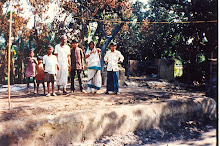
Wagha,
Punjab – Atari, Punjab, India-Pakistan Border Crossing
Sachi
G. Dastidar
The fallout from the
1947 British-created Muslim League-demanded India-Pakistan border can be
witnessed firsthand in the Wagha, Punjab and Atari, Punjab border crossing of
Pakistan and India. This border crossing was created when British India’s
Punjab Province was partitioned to (west) Punjab Province of Pakistan and that of
(east) Punjab State of India. In that process almost the entire Hindu, Sikh,
Jain, Buddhist and Christian minority was wiped out of Pakistan (after the 1947
partition.) In case of India although her Muslim population went down a bit
after 1947 partition as most of her Muslim-majority areas became part of
Pakistan but it has risen faster than the majority Hindu-Sikh-Jain-Buddhist-Christian
population in spite of huge influx of Hindus, Sikhs, Buddhists, Jains, and
Christians from Pakistan, Bangladesh, Pakistani Kashmir and Afghanistan.
The saga of the divide can
be seen when one crosses the border line – if one can really cross it. This has
been the sole border crossing for over six decades between the second-most and
the sixth-most populous nation on earth. As Dastidars tried to cross the
borders from Pakistan to India, their first attempt failed as they reached the
crossing at 3:15 PM. The officials told them the border is open only for five
hours till 3 PM, unless you are a very important person for whom it is open
till 5 PM; which Dastidars were not. All attempts of their Pakistani hosts to
prove to the border officials that their guests were important failed. Thus
they had to make a second trip to cross the border.
But, as you see in the
pictures below, the entire crossing was given to them as they were the only
travelers trying to get to the other side.
The travelers were
invited to stay till 5 PM to witness the spectacle of border closing ceremony –
many locals call it tamasha – whereby
the border guards do a dance-march to officially close the border gates and
finally shaking hand with the other side! Dastidars refused to attend that
ceremony because the border is supposed to be for people and good to pass
through, not for dance-march.
One non-Hindu,
non-Hindi speaking minority Indian told the visitors that a few years back in a
gesture of friendship Indian and Indian-Punjabi officials gave over 500 visas
to Pakistanis for watching a cricket game played across the border in Indian
Punjab. According to that official at the end of the prescribed period several
“guests” did not return back to Pakistan, and a few of them engaged on terror
activities in India.
But the twin jewels of
Punjab, cities of Lahore and Amritsar, barely 50 miles apart are worlds away.
In one speaking the native Punjabi is considered almost “uncultured” for Urdu,
a language of North India, whereas in the other Punjabi language has been saved
through teaching in classrooms and writing in Gurmukhi script. In one city killing
of any animal for food is almost non-existent whereas in the other even the
breakfast starts with animal flesh. In one city women jostle with men in public
transport, whereas in the other city public transport is almost non-existent
for women. One of the cities has become linguistically homogeneous speaking
only Urdu, while in the other one frequently hears along with Punjabi and
Hindi, Bhojpuri, Oriya, Malayalam, Bengali, Gujarati, Telugu and many more
languages. In Lahore, Pakistan there are certainly more women drivers than a
so-called liberal city of Kolkata (Calcutta) in India. Lahore was a
Hindu-majority city before 1947 partition with many famed Hindu temples and Sikh
gurdwaras (temple.) The visitors asked their taxi to take them to a Hindu temple. After hours
of search he came back with sad face, “Sahab,
Sir, I was told the last Hindu mandir (temple)
called Jain Mandir was brought down two years back.” Then he took the visitors to
a “Hindu temple” which was an abandoned Sikh gurdwara maintained by a Muslim
guard paid for by the British Sikhs. The driver took them, along with their host
Didiji and Shakeela to Harappa – where they were the lone visitors. The small unkempt
sign to Harappa ruins in Urdu was barely visible from the highway as the driver
missed the turn. Seeing the visitors ordering each copy of their English
booklets, the salesman commented, “Sir, you must like to read.” Dastidars also
visited Nankana Sahib, the Birth Place of Guru Nanak, and the Founder of
Sikhism. The guard first said “Only Hindus and Sikhs are allowed in,” but
relaxed the rule for their local Muslim companions as they were coming with
Hindus. Absence of religious diversity in Pakistan has affected its intellectual
heritage too. The beautiful British-era National Museum of Lahore contain some
of the precious gems of Indian civilization, e.g. statue of starving Buddha,
lion pillars of Asoka, old manuscripts, marble footprints of Jain, ancient statutes
of Hindu deities and more. But an old Bengali manuscript is identified as
Sanskrit, while a Sanskrit manuscript is depicted as Tibetan, and statue of
Goddess Lakshmi (of wealth) is identified as goddess of music and dance
(Saraswati.) On the other hand some of the old places are saved in exemplary
form including the British-established Government College University, the Mall,
Foreman Christian College, the canals, Lahore University, Badshahi Mosque,
Lahore Fort and more.
Yet there is hope! On
that visit, as Dastidars were traveling from Peshawar to Lahore in a modern
air-conditioned Daewoo coach, they were befriended by two young ladies –
professor Shakeela and her younger sister Shabnam – who “kidnapped” them to
take them to their home in Sabzazar neighborhood of Lahore by canceling
Dastidar’s hotel reservation. (Two ladies had cell phone, but Dastidars did
not.) Their mother, Didi or sister for Dastidars, born in East Punjab, India
would repeatedly mention that they were blessed to have the first ever Hindu mehman – honored guests – in their home.
Shakeela’s poor brother Rizwan was delighted to drive their “Hindu uncle and
aunt” to the border twice in two days!

The Empty Wagha-Atari Broder Crossing

Waiting To Cross the Divide; Send off by (Muslim) Pakistanis

The Line that Divides the Partitioned Nations

The Broder from Indian Side

(Hindu-Sikh) Welocme in India

Didi (left) saying Good Bye to her Hindu Guests

Sabzazar Neighborhood Park

Goverment College University, Lahore

The Sikh Gurdwara; the Muslim guard Explaining

Lahore National Museum

The Lion of Asoka; Symbol of Government of India in Lahore National Museum

The Fasting Buddha

Marble Footprints of Lord Jain

Statue of Ma Durga, Goddess of Strength

Old Stone Tablet at Lahore National Museum


 Wagha-Attari, Punjab, Pakistan-India Border