Showing posts with label Islam. Show all posts

Monday, July 27, 2020

Sri Tapan Ghosh: Fighter for Reclaiming West Bengal Identity

Sri Tapan Ghosh

Fighter for Reclaiming West Bengal Identity

Sachi G. Dastidar

For Partition Documentation Project, New York


Mr. Tapan Ghosh, a noted political activist passed away in Kolkata on July 13, 2020, sadly through Corona Virus infection.

Mr. Tapan Ghosh was a pioneering in his political activism. Since partition of Bengal and India in 1947, politics of both Bengals took extremist bend. Eastern Bengal or East Bengal or East Pakistan or Bangladesh took an intolerant anti-Hindu Islamist bend with millions of Hindus killed over time, with tens of millions of Hindus fleeing for partitioned West Bengal State of India. While western Bengal or West Bengal increasingly became intolerant anti-Hindu Left, also called “communal communism” ruled by Communist Party of India-Marxist or CPM, yet almost all their leaders chose not to live in Muslim-majority East Pakistan or Bangladesh, for Hindu India which gave them shelter. (CPM massacred many Hindus, most notable of them were killing of Hindu monks and nuns in the heart of Kolkata https://empireslastcasualty. blogspot.com/2009/07/hindu-monks-and-nuns-killed-in-india-by.html, and killing of thousands of oppressed-caste Bangladeshi Hindu peasant refugees in Marichjhapi island in southern West Bengal https://empireslastcasualty.blogspot.com/2009/08/marichjhapi-west-bengal-india-communist.html. No one has been arrested for those killings, including during anti-Communist Trinamool Congress Party Government, 2010s.)

In West Bengal, India with the rise of communal Leftism – similar to racism of the West - from 1970s, and even earlier during Congress Party rule from 1947 through late 1970s, a tradition developed among Indian Bengali Hindus, including Hindu refugees who fled their Muslim majority nations of Pakistan and Bangladesh, of their identity, as not calling them Hindu, censoring anti-Hindu atrocities in Pakistan, Bangladesh and India, not teaching uncensored Indian history during colonial Islamic ruler and Islamic settler rulers from Central Asia, as well as during colonial British history, although anti-British history was not fully censored. They also stopped teaching ancient Indian/Hindu literature till 1800s in schools and colleges as they were “Hindu” literature as all the literature had to do with worshiping Mother Nature, plants and animals, to sun, moon and water, the six seasons, deities and more, as Hindus worshiped all of those and literature were enmeshed with those. This colonial mindset also affected millennia-old music, dance,

Surprising, a young man named Tapan Ghosh rose from that soil who openly identified himself as Hindu, and started talking of defending Hindu tradition and literature. This was something very new in 1960s through 2000s. Bengali elites termed such people as “communal” to hide their own communalism. To bridge the divide between Bengali Muslims and Hindus Mr. Ghosh made trips to Bangladesh as well and to Muslim-majority areas in West Bengal in India. In 2007 he formally developed Hindu Samhati, or Hindu Togetherness, a nationalist organization, which included all groups, to empower Hindus, especially Hindus in Hindu-majority West Bengal, India who feel oppressed by the state and elites. This is something risky in violence-ridden and censor-prone politics of West Bengal. He also opposed Neo-colonialism of the elites.

One of the taboos Hindu Samhati and Mr. Ghosh broke is to raise the censored issue of killing and destruction of Hindus and Hindu shrines in Bengal – West Bengal and Bangladesh – since non-native Islamic rulers invaded Bengal and started Islamic conversion. (This writer’s own 300-year old Kali Mandir of the Black Mother was destroyed during 1950s pogrom.) It is still a taboo, but Mr. Ghosh’s Hindu Samhati published politically-incorrect calendars documenting anti-Hindu atrocities in Bangladesh and West Bengal from earlier times till the present. Mr. Ghosh presented two of their calendars, 2018 and 2020, that document some of these atrocities to Partition Center. These are completely censored in history books of Bangladesh, West Bengal, India, America and the West, and by liberal and illiberal press.

In some ways his movement may be compared to Black Lives Matter movement in America, or Armenian Genocide remembrance movement among Armenians, or Jewish Holocaust remembrances in Europe of remembering their oppressive historical events, and give courage to victims.

Sri Ghosh visited Partition Center, and visited Partition Center volunteers in India.

Ghosh with Little Saraswati of New Jersey During His Visit to the U.S.

Let us pray for his soul, as we say “He is resting in Mothers Bosom in the Heaven.” Om Shanti! Om Peace!

His last speech was on June 20, 2020 on Paschim Banga Dibas or West Bengal (Establishment) Day, at a virtual event. https://www.youtube.com/watch?v=bDLOdAvOrJ0 The lecture is in Bengali.


Here are pages from 2018 and 2020 calendars.

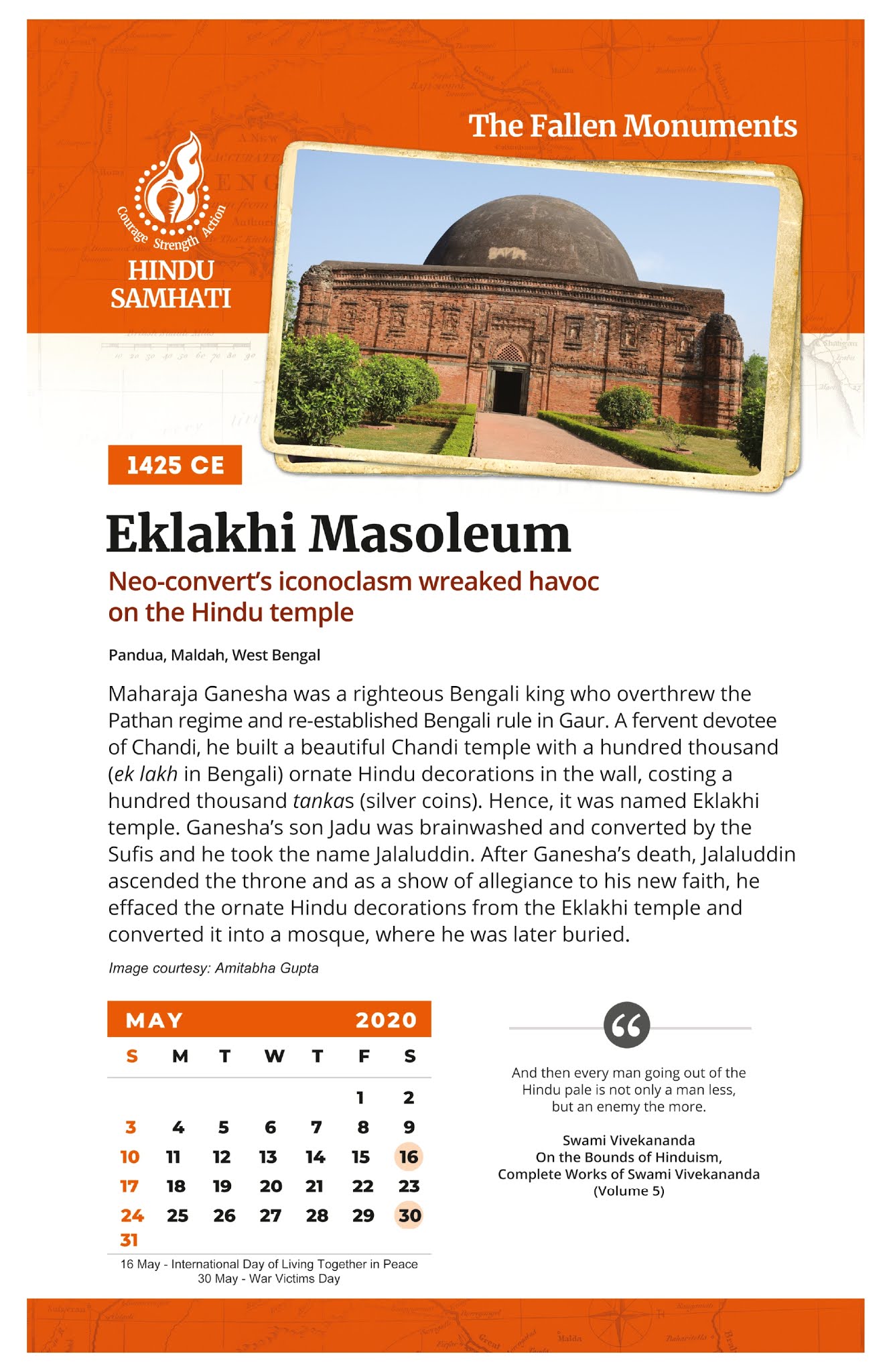
2020 Calendar

(The Calendar Highlights 12 Mosques Built after Destroying Hindu Mandirs [Temples])


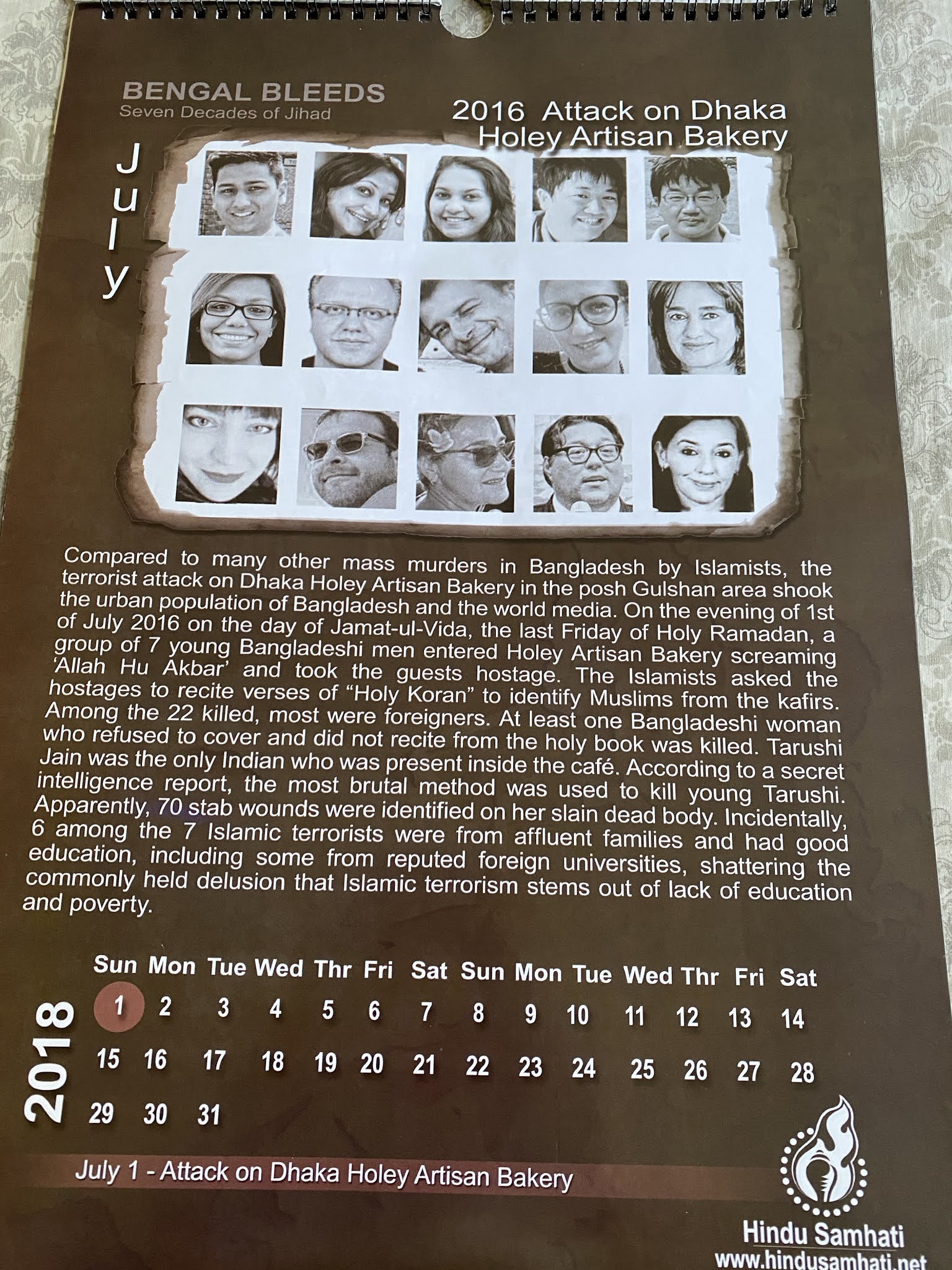
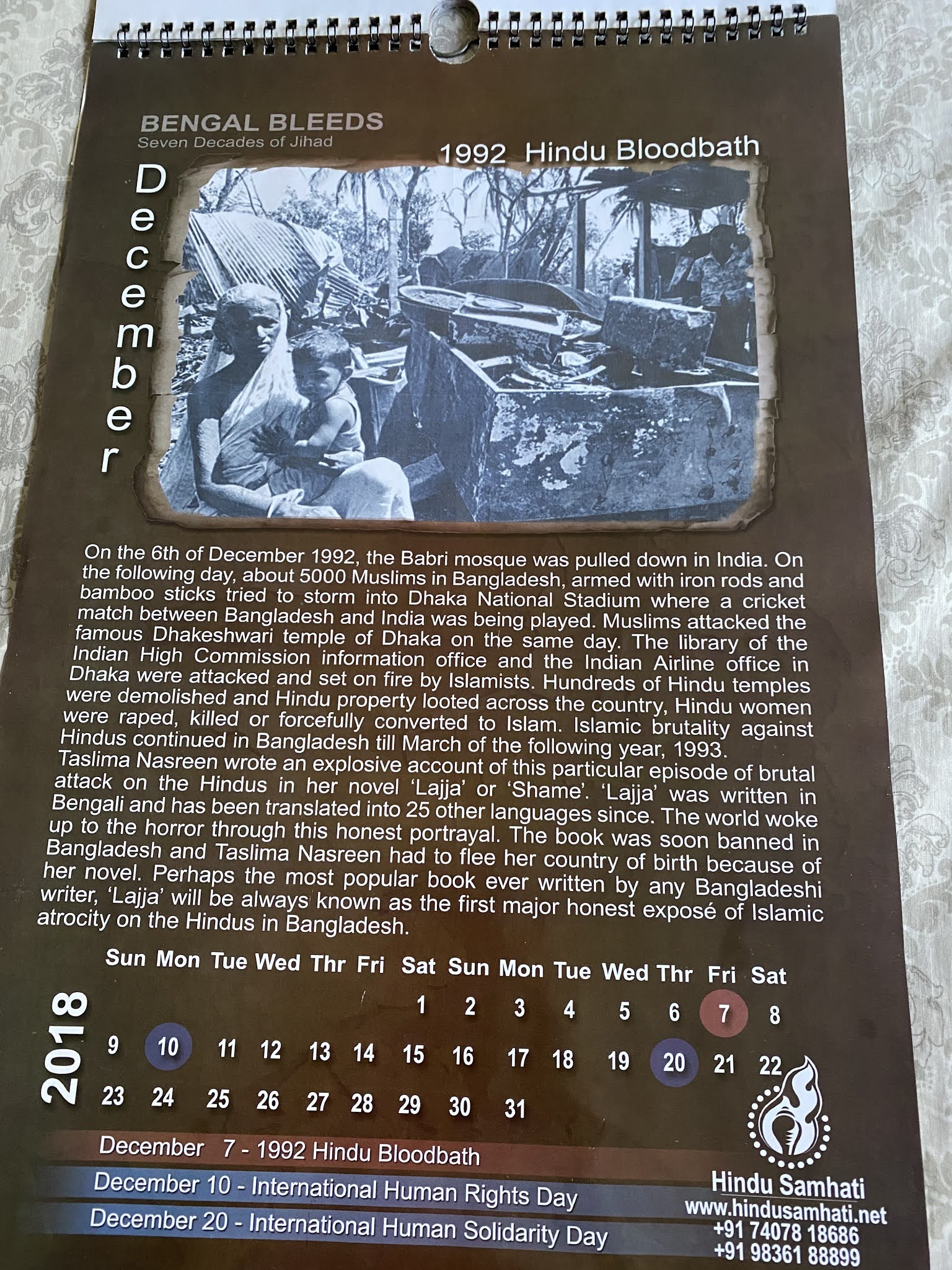
2018 Calendar
(The Calendar Highlights 12 Major Mass Killings of Hindus and Buddhists in Bengal in the Recent Past)


January: 1964 East Pakistan Killing

February: 1950 Dhaka Killing

March: 1971 Operation Searchlight
April: 1992 Logang Massacre
May: 1971 Chuknagar Massacre
June: 1971 Golaghat Massacre
July: 2016 Attack on Dhaka Holey Artisan Bakery
August: 1946 Great Calcutta Killing
September: 2012 Ramu Violence
October: 1946 Noakhali Genocide
November: 2001 Post Election Attacks
December: 1992 Hindu Bloodbath


Tuesday, December 24, 2019

Multan Lecturer Sentenced to Death on Blasphemy Charge


https://www.dawn.com/news/1523612 December 22, 2019


Shakeel AhmedDecember 22, 2019


Junaid Hafeez was booked on a blasphemy charge on March 13, 2013. He was arrested the same day. — Dawn/File.

Junaid Hafeez — a visiting lecturer at the Department of English Literature of the Bahauddin Zakariya University (BZU), Multan — was booked on a blasphemy charge on March 13, 2013. He was arrested the same day.
The trial began in 2014 and the court reser­ved its verdict on Dec 18.
Additional District and Sessions Judge Kashif Qayyum announced the decision on Saturday in the presence of the accused at the New Central Jail.
The court found Hafeez guilty of all charges and handed down 10-year imprisonment under Section 295-A (deliberate and malicious acts intended to outrage religious feelings of any class by insulting its religion or religious beliefs); life term under Section 295-B (defiling, etc, of Holy Quran) and death sentence under Section 295-C (use of derogatory remarks, etc, in respect of the Holy Prophet) of the Pakistan Penal Code.
It also imposed a collective fine of Rs 600,000 and in case of default he would have to undergo an additional one-year imprisonment.
“All the sentences shall run consecutively and the accused would not be entitled to the benefit of Section 382-B CrPC because in case of blasphemer, this court has got no circumstance for taking lenient view and it is also not permitted in Islam,” ruled the court.
Section 382-B of the criminal procedure code says the length of any sentence of imprisonment imposed upon an accused person in respect of any offence shall be treated as reduced by any period during which he was detained in custody for such offence.
As many as 15 prosecution witnesses recorded their statements against Hafeez while 11 others were not called for being declared irrelevant.
The hearings of the case were held inside the prison due to security concerns.
In April 2014, the Human Rights Commission of Pakistan (HRCP) expressed serious concerns when death threats were extended to Special Task Force Coordinator of the HRCP Rashid Rehman Khan, who was representing Hafeez in court.
Mr Rehman and another person appeared before the judge on April 9 and during the arguments for acquittal, three persons addressed Mr Rehman in the judge’s presence and said: “You will not come to court next time because you will not exist anymore.”
He drew the court’s attention to the threat but the judge was reported to have remained silent.
Mr Rehman was gunned down in the HRCP office on May 7 by unidentified gunmen. Chehliyak SHO Abbas Gill was suspended from service over his failure to protect Mr Rehman despite the fact that he and the HRCP complained to police about the threats he had been receiving. On the report of the Chief Minister’s Inspection Team, then SSP Operations Shaukat Abbas too was suspended.
In July 2015, another lawyer for Hafeez submitted an application to police that he had been receiving threats with a warning to withdraw himself from the case.
Also, the BZU administration succumbed to the pressure of a religious group the next year and removed Dr Sheerin Zubair, the chairperson of the English department, and initiated an inquiry against her.
Meanwhile, the HRCP said it was dismayed by the verdict handed down to academic Junaid Hafeez.
“The HRCP believes that the blasphemy laws are heavily misused. This is compounded by a trial process ridden by delays and pressures at the level of the lower judiciary. The offence itself is already associated with vigilantism and entrenched impunity — underscored by the 2014 murder of Hafeez’s lawyer, Rashid Rehman. The resulting pressure on lower courts becomes apparent when most such verdicts are overturned by the High Court or Supreme Court,” it says.
The HRCP reposed its faith in the higher judiciary and expressed hope that “the verdict will be overturned in appeal”.
Published in Dawn, December 22nd, 2019

Friday, December 11, 2015

Mukti: Free to be Born Again – Partitions of Indian Subcontinent, Islamism, Hinduism, Leftism and Liberation of the Faithful -- Book


Dear Friend:

            I am pleased to inform you that my book, Mukti: Free to be Born Again – Partitions of Indian Subcontinent, Islamism, Hinduism, Leftism and Liberation of the Faithful, has been released in the U.S. by Author House. It is a 684 page book available on hard cover, soft cover and as eBook. In the US it is available in bookstores, Amazon, Barnes & Noble, Author House, ISPaD: Partition Center Office in Jamaica, Queens, NYC and more. Attached is a copy of the front and back covers.

Here is a bit from the book’s Preface, “Mukti is a product of love and pain of at least three decades. It is a byproduct of over three decades of field work, social work and travel in the 1947 Partition-affected Bengal –Bangladesh (formerly East Pakistan), West Bengal State of India – as well in the neighboring states…….During my travel in Muslim-majority Bangladesh I have come across the term ‘mukti’ from many, especially indigenous pre-Islamic Hindu, and lately Buddhist, families as they pray for liberation from their suffering.The book is directed towards Western readers many of whom may have heard of India, yet very little is known about post-partition Muslim-majority Bangladesh and Hindu-majority West Bengal, the effects of Indian Partition on the people of the Bengali-speaking region, the former mixed Hindu-Muslim Bengal Province of Colonial British India……Yet the privileged-caste Hindu-refugee elites quickly rose to power in two Hindu Bengali-majority states in India: West Bengal and Tripura. They would champion liberal, left and Marxist ideologies but refused to show solidarity with the oppressed, mostly belonging to Hindu oppressed castes [whom they left behind] Seeds of Mukti was first sown in early 1990s when many of my friends and associates asked for translation of my Ai Bangla, Oi Bangla (This Bengal, That Bengal.)…..The Bengal of British India was known to be a relatively-tolerant mixed Hindu-Muslim society where both Hindu and Muslim nationalism played significant role. In a surprise twist of history after Partition of Bengal and India in 1947 both Bengals took stride towards intolerant politics, one…Islamism, the other….Leftism, led by Bangladeshi (East Pakistani) Muslims and Bangladeshi (East Pakistani) Hindu, albeit refugee. The book delves into that ethos and contradiction, although politically incorrect and, at times, impolite…..I have no power to protect individuals and families who have shared their deepest feelings to my family. I have no power to protect their villages either. As a result I have not used the real names of individuals, villages and neighborhoods….

Here are some sites on the Internet where the book is listed: 

Price of the book: $35/$30/$5 for hardcover/paperback/eBook; (At Partition Center Office in NY only paperback is available.)

Amazon: http://www.amazon.com/Mukti-Partitions-Subcontinent-Islamism-Liberation-ebook/dp/B0178DD6BG/ref=sr_1_1?ie=UTF8&qid=1448802232&sr=8-1&keywords=mukti%3A+free+to+be+born+again
Other book sellers,
Ispad: Indian Subcontinent Partition Center Office, Jamaica, Queens, New York City, www.ispad1947.org and Phone: 917-524-0035.

 Sachi G. Dastidar

Radio Interviews in the U.S.:

With Cheryl Nason: http://webtalkradio.net/?s=INSIDE+THE+WRITER%27S+CAFE

With Stu Taylor: https://www.dropbox.com/s/blp2967jcuncsok/663916_mp3.mp3?dl=0 

With J. Douglas Barker https://www.dropbox.com/s/xrpttxpayoirj4o/663916.mp3?dl=

TV  Interviews in the U.S.
With Ashok Vyas of ITV of New York https://www.youtube.com/watch?v=gOFyuoEa2K8&t=136s   
  

Here are a few of the comments:

Dr. Dastidar: 
Have a great Thanksgiving, Sankaranti, Pongal and all clustered festival. A safe one. My warmest congratulation on a magnum opus. I had some ideas on Bangladesh Issues (as one deep rooted in Anthropology for many years) but have become intensely sensitive (after learning from conversations and review of Prafulla Mukerji's efforts in this area). 
Congratulations again,
            Hari Om,
            Dr. Akkaraju Sarma, U.S.A.; November 26

            Congratulation. As you know I am working very much in this area. Let us keep in touch.                     Manasda
            Prof. Dr. Manas Chatterji, U.S.A.; Nov 26

            Dear Sachi,
            Happy Rush Purnima and Thanksgiving to you too. And congratulations on the release of your book. I will most certainly look into it.
            Namaskar,
            Sunil
            Prof. Dr. Sunil Kukreja; U.S.A. Nov 26

            Sachi da
            Can I buy 5 copies of the book? 
            Milita Chanda, U.S.A.; Nov 26

            Dear Dastidar, 
            Pl accept our heartiest congratulations on the new publication, May GOD bless you all, With fond regards, 
           Verma
            Brig. Gen. S. Verma, U.S.A.; Nov 26

           Congratulations, Sachi for the fulfillment of your four decades of work in bringing this book     out for the Westerners, especially.
           Hope you are doing well.
           Sincerely,
           T.K.Mani, U.S.A.; Nov 26

           Dear Mesho Uncle,
           Congratulations on the book. I just downloaded on Amazon and look
forward to reading it.
            Best regards,
            Udayan 
            Udayan Chattopadhyay, U.K.; Nov 26

            Dear Sachi
            Glad to note that you have wrote a book on such an important subject.
            When an opportunity arises I will certainly go through the book.
            Congratulations.
            Vaskarda
            Partha Roy, India; Nov 26

           Congrats Sachi 
           Looks and sounds interesting. It's a life time of good work by you.
           Tom
           Prof. Dr. Tom DelGuidice, U.S.A.; Nov 27

           Congratulations dada ! 
           It is a remarkable achievement of your dedication to our community. I will collect one copy for myself. 
           Enjoy your upcoming holidays with your family and friends. 
          With the best 
          Selima Ashraf, U.S.A.; Nov 27

          Thank you Dada. 
           I like to buy one of your book with soft cover. Also you can share this in Facebook may be more people will be interested. Should I email to other people who will be interested to have as they are in other countries?
           Thanks again.
           Mousume Sarker, U.S.A.; Nov 27

           Hello Sachi,
           Happy Thanksgiving.
           It is wonderful that you and Shefali could find time from your busy schedule to write two books regarding the partition. It seems "Memoirs of Homeland" is available in Kolkata only.
           Thank you and congratulations.
           Regards,
          Amitabhada 
          Amitabha Chatterjee, U.S.A.; Nov 28

          Congratulations dada.!!!
          Dr. Helen Roy, U.S.A.; Nov 28

          Congratulations!
          I too am one of those who knows almost nothing about this.
          Best regards,
          Edi
          Prof. Dr. Edlslav Manetovic, U.S.A.; Nov 29

           Dear Sir,
            Thank you. Preface of the book is very much interesting of historical perspective. How can I collect one copy?
            Regards,
            Ajoy Kumar Bose, Bangladesh; Nov 28

            Dear friend Sachi:
          Congratulations.  I am sure your publication will be received eagerly by research scholars  all over the world .  
           Best wishes.  
           V. Subramanian, Nov 29

           Dear Sabyasachi
          Congratulation for  the publication of your new book-Mukti. We shall look forward more contribution from your hand.
          Chittada
          Prof. Dr. C. R. Pathak, India; Nov 29

           Dear Sachi,
           Congratulations on this great accomplishment!
            Best,
            Rita
            Prof. Dr. Rita Colon-Urban

           Friends
           This book is an eye witness account of my friend, Dr. Sachi Dastidar, a Bangladeshi Hindu refugee.
          You might be interested in reading what happened to Hindus of Bangladesh.
          Bal K. Gupta, U.S.A.; Nov 29

          Congratulations!!!!!
          Khusi
          Dipika Basu, U.S.A.; Nov 29

          
         Dear Dr. Dastidar,
         Namaskaar.
         Congratulations on the new book !
         Would like to know if this would be available in India payable in INR? If so, when? Kindly let me know at your utmost convenience.
         Thank you sir.
         Best regards,
         Rajiv
         Rajiv Verma, Nov 29

         Congratulations!
         Judy
         Prof. Dr. Judith Walsh, U.S.A.; Nov 30

         Congratulations!
           Prof. Dr. Santanu Datta, U.S.A.; Nov 30

           Dear Sachida,
         Have you considered sending this blurb to the online (and print) magazine Swarajya (www.swarajyamag.com), which is an ideal outlet for the promotion of your ground-breaking work?
May I forward it to them? (I think it is better that you do so yourself. I believe they will be honoured to hear from you.)
          Dileep
          Prof. Dr. Dileep Karanth; U.S.A.; Dec 3

          Great News. Congrats
          Jaydeep Biswas, U.S.A.; Dec 8, 2016

           Sachida,
           Great work; on this subject. How we can listen to that? Can I get an
original Bangla book 'Ai Bangla, Oi Bangla'?
           Make a Book publishing ceremony in  ISPaD: Partition Center Office in Jamaica,
           Sincerely,
           Khourshed
           Khourshedul Islam, U.S.A.; Nov 27, 2016

Dear 
Dr. Dastidar


We wish you and your family a Very Happy, Healthy, Safe and Prosperous New Year 2016! 

We were in California with our son Dr. Rajesh Gupta and his family. 
They gave me your book "Mukti" as a Christmas gift. We came back to-day and will start reading it from to-morrow. 

Kusum and Bal Krishan Gupta


Dear
Hare Krishna!

"Apart from his eight principal wives, Krishna is described to have married several junior women, he rescued from the demon Narakasura. The Bhagavata Purana and the Harivamsa (appendix of Mahabharata) state that 16,000 women were rescued. (Ref. Wikipedia)

Demon Narkasur had forcibly married all the kidnapped girls. When Lord Krishna killed Narkasur,they became widows. But Lord Krishna married them all with Hindu rituals and took them to Dwarika.

Lessons: Lord Krishna started widow marriage and marriage of kidnapped girls. ISKCON and other Hindu sects, should follow Lord Krishna and start marriages of  Hindu widows and that of kidnapped Hindu girls in Bangladesh. I am sure they can achieve a target of 16,000 by Krishna Janamshtmi. (Hindu and Sikh refugees from of Pakistan in 1947, performed hundreds of thousands [lakhs] of such marriages.)

You may forward it to Hindu leaders in Bangladesh and ISKCON devotees worldwide. May Lord Krishna bless you in rescuing Bangladeshi Hindu women!

Bal Krishan Gupta, USA
February 29, 2016

************************
I am reading your book now. It's an absolute masterpiece.

Dr. Arvind Chandrakantan
April 3, 2017
         
************************

Sachida,
I meant to ask you this question for a while - just did not know what you would think so I did not ask you earlier. Will you please consider making the book available online in PDF format? I think that book will be an eye opener for lot of people, as it was for me. Your writing changed my perception 100% - and I am  sure it will affect others also. Please consider this request - people need to read this book. You can have it on ISPAD site or FB or we can create a new website for you as an author (sachighoshdastidar.com). I want to show your site and work to people and make them aware of your work. 

Please let me know what you think - I can help in any way I can

Thanks,
Milita
October 3, 2017

*************************************************

Hi:

I am a slow reader and it will take a while, but  enjoying it so far.

Saumya
Chicago
8/25/2018

**************************************************
Dear Professor Ghosh-Dastidar:

I am Rudranath's mother. I read your book and was really impressed. I will be happy if you could please discuss the book with me whenever you are free.

Best wishes,
Monica Talukdar, Uttarkhand, India
January 25, 2020

***********************************************

Hi,

This is I wrote Amazon reviewing your book.

Dr. Sachi Dastidar's monumental work - Mukti: Free To Be Born Again - is an intensely personal but extraordinarily researched book and one integrating an amazing range of knowledge of post-1947 India with his own family's history. It is simultaneously both informative and horrifying, documenting a tragedy ignored almost equally by the world as well as most of his fellow Indians. Mukti focusses, in particular, on Dastidar's native Bengal, a part of pre-partition India ripped apart twice, once after Britain relinquished power in the late '40's and again in 1971 when the area, then known as East Pakistan, was attacked by West Pakistani forces as the new nation of Bangladesh struggled to achieve independence. 

     It's subsequent history is an appalling saga of the ongoing effort to eradicate the Hindu population of Bangladeshi Bengal by forced removal, massacres, and continuous persecution by Islamist elements. The age-old Bengali culture one that had both Hindu and Moslem
features, is being slowly eradicated.
 
     In some ways, the worst aspect of this decades long tragedy is how most of the expatriate Hindu population, refugees from East Pakistan/Bangladesh, many of them now secularized members of Calcutta's elite, have abandoned any concern for their poorer, rural Hindu relatives left behind in the mass immigrations since 1947.
 
     Dr. Dastidar passionately defends the integrity of the traditional Bengali culture, praising it's reverence for nature and the environment, while criticizing it's negative characteristics, such as the
vestiges of the caste system and the ahistorical nature of the Hindu faith. He  laments the failure of late 19th and early 20th Century reform movements like those of Aurobindo and Gandhi to forge
 
     Dr. Dastidar's work is epically long (668 pages), requiring a dedicated perseverance to travel it's length. And, as a personal journey taken with numerous family and friends, it can be confusing at
times in terms of the frequent change of characters, with their Indian names necessitating concentrated attention. Nevertheless, the account with it's remarkable record of a decades long pilgrimage, along with much colorful detailing of places, cuisine, costumes and. customs,
and the dreadful history it so vividly documents, makes reading Mukti a compelling but disturbing experience.
                                             
Lorne
Long Island, New York, U.S.A.
March 28, 2020
         
*********************************************

Wednesday, March 18, 2015

Prophets of Peace and War


Franklin Graham: Muslims Kill Christians To Emulate Muhammad

by Shoebat Foundation on March 9, 2015 in FeaturedGeneral

The Rev. Franklin Graham says that just as he tries to “emulate” Jesus, who was “a man of peace,” Muslims try to emulate their leader, who “was a man of war.”

“Muhammad was a man of war and he killed many people,” Graham told Tucker Carlson on “Fox & Friends Weekend” on Sunday. “Jesus Christ came as a man of peace, and as a follower of Christ I follow him and I want to emulate Him. But the followers of Islam are emulating the prophet Muhammad, and that’s what you’re seeing carried out.”

“We have to be very careful and understand that Islam — the teachings of Islam — are militant,” the president of the Samaritan’s Purse charity said. ” I’m talking about, when you read the Quran, when you read the Surra, it’s very militant.”

According to Graham, one of the reasons for the rise of Christian persecution in the Middle East was the fall of the former Iraqi leader Saddam Hussein.

“When Iraq was invaded by our country — and I’m not saying this was right or wrong, I’m just saying it’s a fact — there was a large Christian minority. Saddam Hussein gave them quite a lot of freedom,” he explained.

“But when that government fell and the new government came to power, the Islamists in the country, al-Qaida and others, began to attack and burn churches,” Graham said.

“We’ve seen that happen throughout Iraq, and now it’s happening in Syria,” he explained.

And now as a result, “the Christian community is being slaughtered by the Muslims, and they’re being forced to leave,” he said.

According to Graham, “there used to be large Christian and Jewish communities in Saudi Arabia. But over the centuries they have been exterminated by the Muslims.

“This isn’t something that has just happened with ISIS. This has been going on for centuries, and has been going on in Egypt,” he said.

“When those Egyptian men [Coptic Christians] had their heads cut off, that’s not the first time,” he said. “That’s been going on in Egypt for a long time.”

However, Graham made it clear that he doesn’t “want the Muslims out there to think that I’m bashing them. I’m not. I love Muslims and I want them to know what I know — that God loves them, that Jesus Christ died for their sins, that he rose from the grave, he can come into the heart, and they can have that hope of heaven and that hope of eternal life.”

The son of the Rev. Billy Graham said that he is also concerned about “persecution [coming] in this country. We’ve already seen many laws that have been passed that restrict our freedom as Christians.

P.S: Please consider the serious issue on Christian persecution which will increase as we see these events unfold. we operate a very effective mission in rescuing fellow Christians. We are a unique organization (Rescue Christians) who rescue Christians, perdominately in Pakistan that live under the Muslim yoke baking bricks in kilns under the heating sun. Christians in Pakistan are also burned in furnaces. To see an example out of the thousands we rescue, click here, and listen to the amazing testimonies first hand on how you can help and make a difference, now in this life and for eternity.

A time for introspection for Muslims


A time for introspection

Muslim moderates have to figure out how to defend equality and democracy against religious arguments for hierarchy and theocracy

Saad Hafiz

·         Saad Hafiz

·         March 08, 2015

 There is a growing desire to understand the root causes of Islamic extremism. This is a natural reaction to the unspeakable horrors that transnational terrorist groups, including the Tehreek-e-Taliban Pakistan (TTP), Boko Haram (translated as western education is forbidden) and Daesh or the Islamic State (IS) are carrying out against innocent people, the majority of whom are Muslims. It is recognised that extremism now poses the greatest challenge to universal human values and world peace.


President Obama has suggested that economic and political grievances are responsible for violence and terrorism in the Muslim world. Mocked by his Republican opponents, Obama encouraged democracy and prosperity to combat militancy. Grand Imam Ahmed al-Tayeb, the head of Al-Azhar, Sunni Islam’s most prestigious seat of learning, linked extremism to “bad interpretations of the Quran and the sunnah”, which have led some people to embrace a ‘misguided’ form of Islam. Al-Tayeb’s rare and candid admission was diluted when he went on to blame unrest in the region, on a conspiracy of “new global colonialism allied to world Zionism”.


Unfortunately, the facts are that the forms of Islam gaining ascendancy — certainly those most influential world affairs today — are the extreme, intolerant forms. It is no longer sufficient to just blame longstanding injustices and twisted ideologies for the brutal atrocities committed by ‘fringe’ Islamic groups. Many (but not all) of the problems facing the Muslim world are indeed self-inflicted, and blaming the west for all of them has set Muslims back from the path of enlightenment.

A major issue is that Islam lacks the traditions that encourage questioning and scepticism, and the test of knowledge through the prism of rationality. Muslims easily succumb to pre-dominant, irrational discourse and actions. Perhaps we can draw hope in the words of linguist and translator Thomas Cleary who said: “Islam does not demand unreasoned belief. Rather, it invites intelligent faith, growing from observation, reflection and contemplation, beginning with nature and what is all around us.” Sadly, most Muslim societies do not allow the freedoms necessary for public introspection and dialogue. At this point it is very difficult to envision reform in the Muslim world that focuses on the maturity and reason of humankind.

It is unhelpful that, for political reasons, partly, rulers of Islamic kingdoms (like past Christian kings) describe themselves as “shadows of God on earth”. This sends out an unequivocal message: anyone contradicting the ruler is also contradicting God. In order to make sure that the populace remains compliant, they construct the image of a God for whom obedience is paramount. To this very day, this plays an important role in dictatorial Islamic states, where any opposition is not only held up as a secular opposition, but also as a movement against God. People defer to the rulers when they have questions about what they should and should not do. Repressive structures intermingle as a result. Christianity has succeeded in overcoming this incapacitation of the faithful. That has not quite been the case in Islam.


Also, most Muslims do not concern themselves with the true essence of the Quran. That is why many Muslims often base the faith on what they are told. We hark back to statements made by theologians in the ninth and 10th centuries. Muslims need to fight the literalism and obscurantism being promoted in many mosques, in religious schools or during courses of theological instruction. It is also too often the case that the lives of Muslims are cloaked with a fatalism based on a misunderstanding of God’s will. In the closed, fearful world of Islamic discussion, a discourse on these issues is considered offensive, dangerous or both. Muslims who mention it are branded disloyal and subjected to intimidation and violence. Reformers who interpret the Quran differently, who say Islam is more than just a religion of rules and regulations, have so far not succeeded in asserting themselves.


Muslim moderates have to figure out how to defend equality and democracy against religious arguments for hierarchy and theocracy. The appeal of radical religious doctrine and practice is obvious today, and needs to be understood if we are to persuade people that religious zealotry is frighteningly unappealing. We should recognise the power of the extremists and the extent of their political reach. We should clearly name the fanatics our adversaries and commit ourselves to an intellectual campaign against them; that is, a campaign in defence of liberty, democracy, equality and pluralism. If Muslims expect religious tolerance, we must ourselves enforce a zero-tolerance policy against hatred and bigotry.


All the great religious civilisations are capable of producing violent fanatics and all faiths in their extreme form carry the possibility of tyranny. However, Islam today seems most susceptible to this malady. Muslims have to step up to the forefront of the struggle for political and religious tolerance, social cohesion and inclusiveness. As a start, this process should consist of two parts. First, do not blame external forces for all your ills. Second, be inclusive and compassionate towards other human beings regardless of their faith because that is what our beneficent and merciful God has willed the believers to do.


The writer can be reached at shgcci@gmail.com